
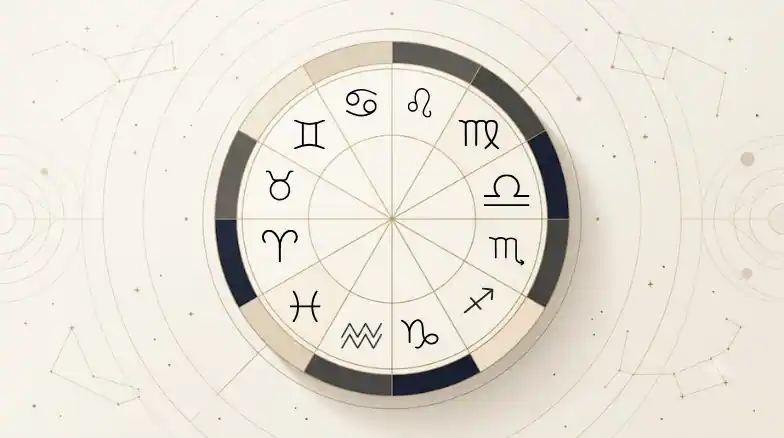
About houses in astrology – imagine your birth chart as a stage.
The planets are the actors, each representing a different part of your personality. The zodiac signs describe how those actors behave, their style, temperament and motivation. The houses are the settings where the action unfolds, revealing the areas of life in which those energies are expressed.
This simple idea is one of the keys to understanding astrology.
Whether you’re looking at love, career, family or personal growth, every interpretation begins with the relationship between planets, signs and houses. Once you understand what the houses represent, reading a birth chart becomes far less overwhelming.
In this guide, you’ll learn what the 12 houses in astrology mean, how they differ from planets and zodiac signs, and how astrologers use them to interpret different areas of life.
Table of Contents
What Are Houses in Astrology?
If you’ve ever looked at a birth chart, you’ve probably noticed that it is divided into 12 sections. These sections are called houses in astrology, and each one represents a different area of life. While planets describe different types of energy and zodiac signs show how that energy is expressed, the houses reveal where those experiences are most likely to unfold.
Think of the houses as twelve chapters of your life’s story. One house focuses on your identity, another on money, another on relationships, career, family, creativity, spirituality, and more. Every planet in your birth chart occupies a house, adding its influence to that part of your life.
This is why two people with the same Sun sign can have very different personalities and life experiences. Even if they share similar planetary placements, those planets may fall into different birth chart houses, changing how the energy is expressed.
Understanding astrology houses explained in this way makes reading a birth chart much easier. Instead of seeing a collection of unfamiliar symbols, you begin to see a map of different life themes and how they connect.
The 12 houses do not predict your future or determine a fixed destiny. Rather, they provide a framework that astrologers use to understand your strengths, challenges, relationships, ambitions, and personal growth. Learning what houses represent in astrology is one of the first and most important steps in understanding your natal chart.
The Simplest Way to Understand a Birth Chart
Houses vs Zodiac Signs vs Planets
One of the biggest challenges for beginners is understanding the difference between houses, zodiac signs, and planets. Since all three appear together in a birth chart, it’s easy to assume they mean the same thing. In reality, each plays a completely different role.
Think of them as three parts of a story.
Planets represent the energy or function. They answer “What?” For example, Venus represents love and relationships, while Mars represents action and ambition.
Zodiac signs describe how that energy is expressed. They answer “How?” Mars in Aries is bold and direct, while Mars in Pisces is more intuitive and adaptable.
Houses show where that energy is most likely to appear in your life. They answer “Where?” Mars in the First House may influence your personality and confidence, while Mars in the Tenth House is more likely to shape your career and public image.
This is why astrologers never interpret a planet on its own. The planet tells you what the energy is, the zodiac sign explains how it behaves, and the house reveals where you are most likely to experience it.
Once you understand this relationship, reading a birth chart becomes much more intuitive. Instead of memorising dozens of meanings, you begin to see how planets, signs, and birth chart houses work together to tell a complete story.
What Each of the 12 Houses Represents
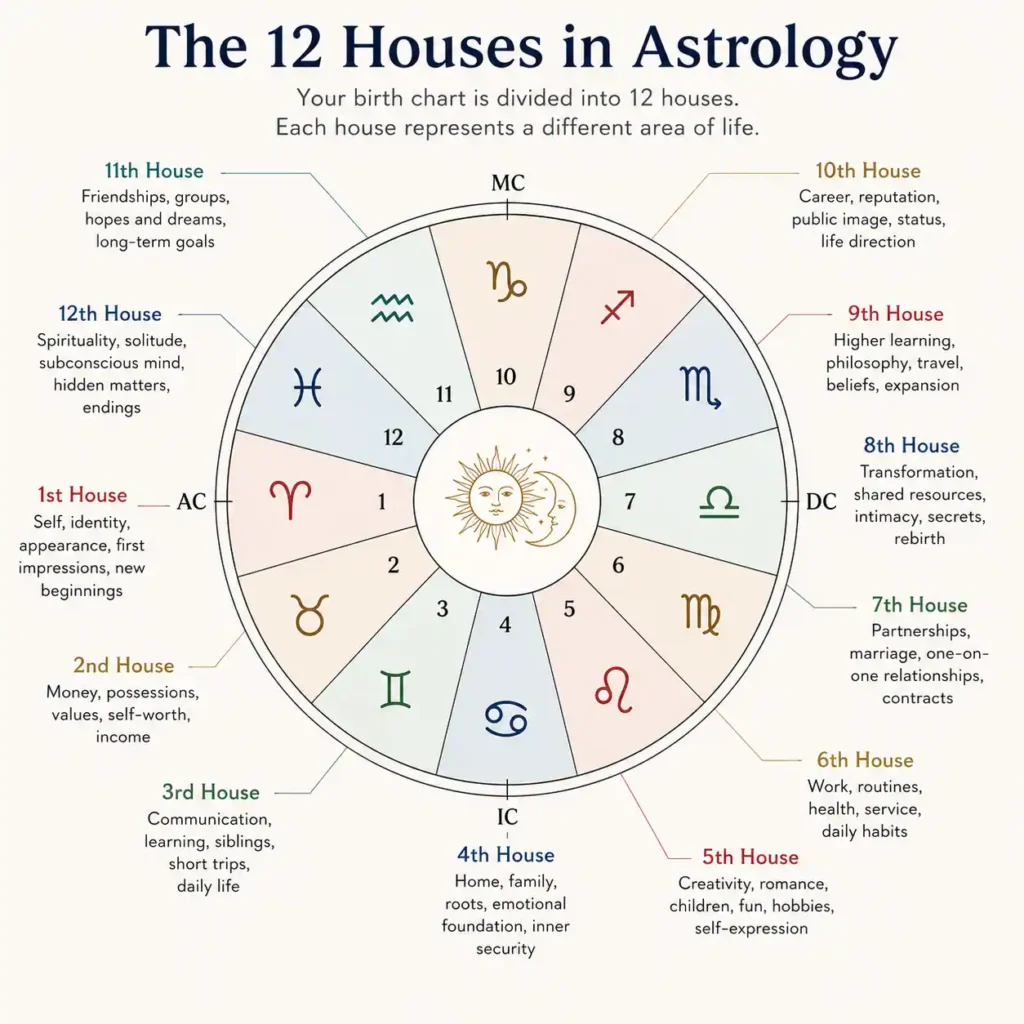
Every birth chart is divided into 12 houses, with each one representing a different area of life. Together, they tell the story of your experiences, from your identity and relationships to your career, finances, creativity and spiritual growth. While every house has its own meaning, they are all connected, helping astrologers understand how different parts of life influence one another.
First House: Identity and First Impressions
The First House represents your identity, physical appearance, personality and the way you approach life. It reflects the first impression you make on others and often describes your natural instincts, confidence and outlook. This house also marks the beginning of the birth chart and is closely associated with new beginnings and personal growth. When astrologers interpret the First House, they are looking at how you present yourself to the world and how you begin your life’s journey.
Keywords: Identity • Appearance • Confidence • Self • New Beginnings
Read next: Sun in the First House, Moon in the First House, Mercury in the First House, Venus in the First House, Mars in the First House.
Second House: Money and Personal Values
The Second House governs money, possessions, personal values and self-worth. It is not only about how you earn or manage resources but also about what you truly value in life. This house can reveal your relationship with financial security, material comfort and your sense of worth beyond money. It also has connections with speech, talents and the skills you develop over time.
Keywords: Money • Self-Worth • Values • Income • Possessions
Read next: Sun in the Second House, Moon in the Second House, Mercury in the Second House, Venus in the Second House, Mars in the Second House, Saturn in the Second House,
Third House: Communication and Learning
The Third House is associated with communication, learning and curiosity. It reflects how you think, express ideas and connect with the people around you. Siblings, neighbours, short journeys and everyday interactions are also linked to this house. It represents the practical knowledge you gain through daily experiences and your willingness to explore the world through conversation and learning.
Keywords: Communication • Learning • Siblings • Curiosity • Short Travel
Fourth House: Home and Emotional Foundations
The Fourth House represents home, family, roots and emotional security. It describes your private life, childhood environment and the foundations that shape your sense of belonging. This house also reflects your relationship with family traditions, home life and the place where you feel most comfortable and supported.
Keywords: Home • Family • Roots • Security • Foundations
Fifth House: Creativity and Self Expression
The Fifth House is the house of creativity, joy and self-expression. It governs hobbies, romance, children, artistic talents and the activities that bring happiness into your life. It reflects how you express your individuality, embrace fun and share your creative gifts with the world.
Keywords: Creativity • Romance • Children • Joy • Self Expression
Sixth House: Work and Well Being
The Sixth House focuses on work, daily routines, health and service. It reveals how you organise your time, develop productive habits and care for your physical well-being. This house is closely connected with responsibilities, everyday tasks and the routines that support long-term growth.
Keywords: Work • Health • Routine • Service • Habits
Seventh House: Relationships and Partnerships
The Seventh House governs one-to-one relationships, including marriage, long-term partnerships and important collaborations. It highlights the qualities you seek in others and the way you build balanced, meaningful connections. Agreements, contracts and committed partnerships are all associated with this house.
Keywords: Marriage • Partnerships • Relationships • Balance • Commitment
Eighth House: Transformation and Shared Resources
The Eighth House represents transformation, shared resources and profound personal change. It explores themes of trust, intimacy, inheritance, investments and emotional growth. Rather than focusing only on endings, this house is often seen as a symbol of renewal and the ability to evolve through life’s deeper experiences.
Keywords: Transformation • Intimacy • Shared Resources • Change • Renewal
Ninth House: Wisdom and Exploration
The Ninth House is linked with higher learning, philosophy, spirituality and travel. It encourages you to broaden your perspective through education, different cultures and meaningful life experiences. This house represents the search for wisdom and a deeper understanding of the world.
Keywords: Higher Learning • Travel • Philosophy • Beliefs • Exploration
Tenth House: Career and Public Life
The Tenth House reflects your career, public image, ambitions and achievements. It shows how you contribute to society and the reputation you build over time. Whether your goals involve professional success, leadership or public recognition, this house represents your long-term direction and aspirations.
Keywords: Career • Reputation • Success • Ambition • Public Image
Eleventh House: Community and Future Goals
The Eleventh House represents friendships, communities, teamwork and long-term aspirations. It reflects the people who support your journey, the causes you believe in and the dreams you hope to achieve. This house reminds us that growth often happens through shared ideas and meaningful connections.
Keywords: Friends • Community • Goals • Networks • Aspirations
Twelfth House: Reflection and the Inner World
The Twelfth House is associated with reflection, solitude, intuition and the unconscious mind. It encourages self-discovery through rest, spiritual practices and inner healing. Rather than being a house of fear or mystery, it represents the quiet spaces where personal transformation often begins.
Keywords: Spirituality • Solitude • Intuition • Healing • Inner World
How to Interpret Houses in Your Birth Chart
Understanding the houses in astrology is only the first step. The real interpretation begins when astrologers look at how each house interacts with the rest of the birth chart. Rather than reading a house in isolation, they consider several factors to understand how that area of life is likely to be expressed.
1. Start with the House
Begin by identifying the house you want to understand. Each of the birth chart houses represents a different life theme. For example, the Second House relates to money and personal values, while the Seventh House focuses on relationships and partnerships.
2. Look at the Zodiac Sign on the House
Every house begins with a zodiac sign, known as the house cusp. The sign colours the way that area of life is experienced. A Fifth House beginning in Leo, for example, may encourage bold creativity and self expression, while a Fifth House beginning in Pisces may express creativity in a more imaginative or intuitive way.
3. Check Which Planets Are in the House
Planets add energy to the house they occupy. Venus in the Seventh House may place greater emphasis on harmony and relationships, while Saturn in the same house can highlight commitment, responsibility or lessons learned through partnership. The house provides the setting, while the planet influences what happens within it.
4. Consider the Ruling Planet
Each zodiac sign has a ruling planet. The condition and placement of that ruling planet provide additional insight into the house. This helps astrologers understand how easily the themes of the house may flow and where further growth or attention might be needed.
5. Read the Chart as a Whole
No single house tells the entire story. Professional astrologers look for patterns across the chart, considering how different houses, planets and signs work together. A birth chart is a complete system, and every placement gains meaning through its relationship with the others.
When learning astrology houses explained, it helps to think of interpretation as a simple formula:
House = Where life happens
Planet = What energy is present
Zodiac Sign = How that energy is expressed
Once you understand this relationship, reading houses in astrology becomes much more intuitive. Instead of memorising dozens of separate meanings, you begin to see how every part of the birth chart works together to tell a complete story.
How Astrologers Read a House
Identify the house you want to interpret.
Look at the zodiac sign on the house cusp.
See whether any planets occupy that house.
Check the ruling planet of the zodiac sign.
Interpret everything together instead of relying on one placement.
Remember: Houses tell you where, planets tell you what, and zodiac signs tell you how.
Do Empty Houses Matter?
One of the most common questions beginners ask is whether empty houses in astrology are something to worry about. If you’ve noticed that one or more of your birth chart houses contain no planets, the simple answer is no.
An empty house does not mean that area of life is missing, unlucky or unimportant. Every person has all 12 houses in astrology, and each one continues to influence different life experiences, whether or not a planet is placed there.
So why are some houses empty? There are only a limited number of planets in a birth chart, but there are twelve houses. As a result, it’s completely normal for several houses in astrology to have no planets at all. In fact, most birth charts contain multiple empty houses.
When astrologers interpret an empty house, they don’t stop there. Instead, they look at three important factors:
The Zodiac Sign on the House Cusp : Every house begins with a zodiac sign. Even if the house is empty, that sign provides valuable clues about how the themes of the house are likely to be expressed.
The Ruling Planet : Each zodiac sign is ruled by a planet. Astrologers examine where that ruling planet is located in the birth chart and how it interacts with other placements. This often reveals much more than simply asking whether the house contains a planet.
The Overall Birth Chart : No house should ever be interpreted in isolation. An empty Fifth House, for example, does not mean a person lacks creativity or romance. Likewise, an empty Tenth House does not mean someone will struggle in their career. The entire birth chart works as an interconnected system, with planets, signs and birth chart houses influencing one another.
One of the biggest misconceptions in astrology houses explained is the belief that more planets automatically make a house stronger or more important. In reality, an empty house can still play a significant role depending on its ruling planet, aspects and relationship with the rest of the chart.
The key takeaway is simple: empty houses in astrology are completely normal. Rather than seeing them as something missing, think of them as areas of life that require a deeper look beyond planetary placements. Understanding this is an important step in learning what do houses represent in astrology and how astrologers interpret the full picture instead of relying on a single placement.
Common Misconceptions About Houses in Astrology
As you begin learning houses in astrology, you’ll come across plenty of myths and oversimplified interpretations. While these ideas are common online, they don’t reflect how astrologers actually interpret a birth chart. Understanding these misconceptions will help you read birth chart houses with greater confidence and accuracy.
Misconception 1: Empty Houses Are Bad
One of the biggest myths is that an empty house means something is missing from your life. In reality, empty houses are completely normal. Every one of the 12 houses in astrology remains active, even without planets. Astrologers simply look at the zodiac sign on the house cusp and its ruling planet to understand that area of life.
Misconception 2: More Planets Mean Better Results
A house with several planets is not automatically stronger or more fortunate. Multiple planets simply place greater emphasis on that life area. Whether the experience is supportive or challenging depends on the planets involved, their relationships with one another and the rest of the chart.
Misconception 3: One House Can Predict Your Entire Future
No single house determines your career, relationships or financial success. Professional astrologers always interpret houses in astrology as part of a larger picture, considering planets, zodiac signs and the connections between different houses before drawing conclusions.
Misconception 4: Every Person with the Same House Placement Has the Same Life
Two people may have similar house placements but very different birth charts. The planets, zodiac signs and overall chart pattern all influence how a house is expressed. This is why astrology is about interpretation rather than fixed rules.
Misconception 5: Houses Never Change
The meaning of the houses remains the same, but techniques such as transits and progressions can highlight different birth chart houses at different stages of life. A house that feels quiet today may become much more significant during another period of your journey.
The best way to approach astrology houses explained is with curiosity rather than assumptions. The 12 houses in astrology are not isolated predictions or labels. They work together as a complete system, revealing how different areas of life connect and influence one another. Understanding this bigger picture is what transforms astrology from a list of meanings into a meaningful tool for self-discovery.
FAQs
What do the 12 houses in astrology mean?
The 12 houses in astrology represent twelve different areas of life, such as identity, finances, communication, family, relationships, career and spirituality. While the zodiac signs describe how energy is expressed and the planets describe what energy is present, the houses show where those energies are most likely to influence your life. Together, they form an essential part of interpreting a birth chart.
What do the houses in astrology indicate?
The houses in astrology indicate the specific areas of life where planetary energies are expressed. Each house governs a unique aspect of your personal journey, from your appearance and self-image to your career, friendships and inner growth. By examining the planets, zodiac signs and house rulers together, astrologers gain a more complete understanding of a person’s birth chart.
How do I find out my house in astrology?
To find your birth chart houses, you’ll need your date of birth, exact birth time and birthplace. Enter these details into a reliable birth chart calculator, and it will generate your natal chart, showing the positions of the planets, zodiac signs and the 12 houses in astrology. Because the houses are calculated using your birth time and location, even a small difference in birth time can change the house placements.
