
To communicate feelings without sounding defensive is something most people want to do, yet struggle with in real life. You finally gather the courage to express how you feel, only for the conversation to spiral into tension, misunderstanding, or shutdown. Instead of connection, defensiveness takes over on one or both sides.
This isn’t because you’re “bad at communication.” It’s because expressing feelings activates deep psychological and neurological responses that most of us were never taught to manage. Research in psychology, neuroscience, and relationship science shows that defensiveness is not a personality flaw but a natural stress response. The good news is that it can be unlearned.
This article breaks down why defensiveness happens, how it damages communication, and seven science-backed ways to communicate feelings without sounding defensive, while still being honest and emotionally grounded.
Table of Contents
Why We Get Defensive When Expressing Feelings
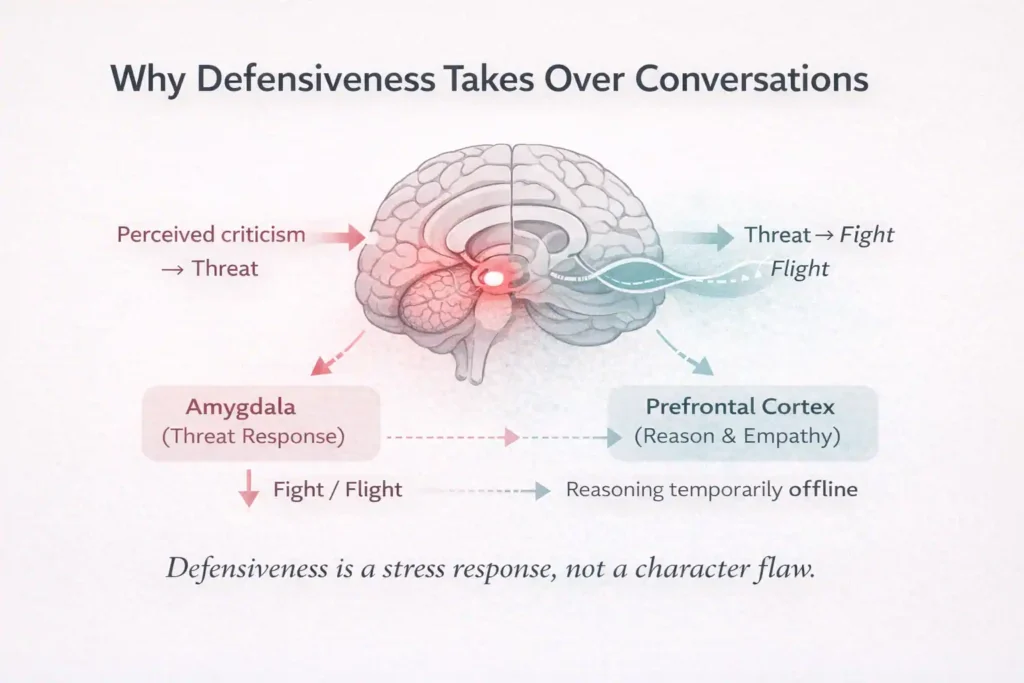
Defensiveness is a self-protective response. When we perceive criticism, rejection, or misunderstanding, the brain interprets it as a threat. The amygdala activates, stress hormones rise, and the prefrontal cortex, responsible for reasoning and empathy becomes less active. This is often referred to as an “amygdala hijack.”
Psychologically, defensiveness is closely linked to:
- Fear of rejection or abandonment
- Shame and low self-esteem
- Insecure attachment styles
Research on attachment theory shows that anxiously attached individuals tend to personalize feedback, while avoidantly attached individuals are more likely to shut down or withdraw. In both cases, the goal is safety, not conflict even though the outcome often creates distance.
According to the Gottman Institute, defensiveness is one of the strongest predictors of negative communication outcomes in relationships. Once it appears, empathy drops and escalation becomes more likely.
Feeling Defensive vs Acting Defensive
An important distinction often missed in communication advice is the difference between feeling defensive and acting defensive. Feeling defensive is automatic. Acting defensive is behavioral.
You can feel anxious, embarrassed, or triggered internally and still choose how you respond externally. The problem arises when emotions bypass awareness and move straight into reaction, interrupting, blaming, justifying, or counter-attacking.
Psychologist Nick Wignall emphasizes that learning to pause between emotion and action is the key to non-defensive communication. That pause allows emotional regulation to occur, which restores access to empathy and perspective.
This is where emotional regulation skills become essential, especially if you tend to feel overwhelmed during difficult conversations.
7 Science-Backed Ways to Communicate Feelings Without Sounding Defensive
1. Use I-Language Instead of You-Language
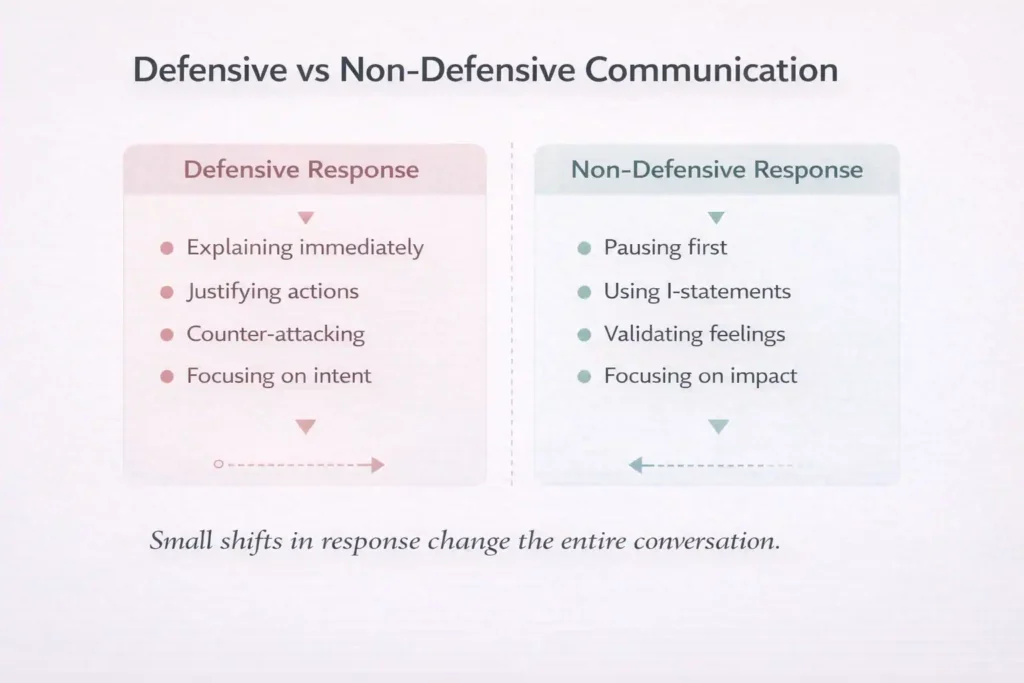
One of the most well-researched communication tools is the use of I-statements. Instead of framing feelings as accusations, I-language expresses internal experience. Compare:
- “You never listen to me.”
- “I feel unheard when I try to explain what’s important to me.”
A peer-reviewed NIH study found that I-language significantly reduces defensive reactions and increases openness during conflict discussions. Statements that acknowledge both self-experience and relational impact are rated as the most constructive.
I-language does not mean avoiding responsibility or truth. It means anchoring communication in personal experience rather than perceived intent.
2. Pause to Regulate Before Responding
Defensive communication often happens when emotions outrun regulation. Taking even a brief pause allows the nervous system to settle enough for thoughtful response. Self-soothing techniques supported by Gottman research include:
- Slow, deep breathing
- Relaxing the jaw and shoulders
- Silently naming the emotion you feel
This moment of regulation reactivates the prefrontal cortex, making empathy and clarity possible again. Without it, even well-intended communication can sound sharp or dismissive.
If emotional intensity tends to hijack your thoughts, this is where emotional regulation practices can make a noticeable difference over time.
3. Validate Before You Explain Yourself
One of the fastest ways to reduce defensiveness , in yourself and others, is validation. Validation does not mean agreement. It means acknowledging the other person’s emotional reality. For example: “I understand why that situation felt frustrating to you.”
Research shows that feeling understood lowers physiological stress responses and creates psychological safety. When validation comes first, explanations are far more likely to be heard without resistance. Skipping validation often triggers defensiveness, even if your explanation is reasonable.
4. Take Partial Responsibility Where It’s Real
Non-defensive communication doesn’t require full blame. It requires honesty. Owning even a small part of a situation, tone, timing, wording, signals humility and reduces power struggles. Studies from the Greater Good Science Center suggest that responsibility-taking reduces ego defensiveness and strengthens trust.
A simple statement like: “I can see how my tone contributed to that misunderstanding” can immediately shift the emotional climate of a conversation.
5. Separate Intent from Impact
Many defensive exchanges stem from the belief that good intentions should cancel out emotional impact. Psychologically, this rarely works.
Impact matters because the brain responds to experience, not intent. Acknowledging impact without defending intent keeps conversations grounded. For example: “That wasn’t my intention, but I can see how it came across that way.”
This approach maintains self-respect while honoring emotional reality, a core skill in non-defensive communication.
6. Practice Active Listening, Not Mental Rebuttal
When we listen while planning our response, we aren’t actually listening. Active listening involves reflecting back what you hear without correction or judgment. This technique:
- Reduces misunderstandings
- Signals emotional safety
- Interrupts defensive cycles
Research from communication psychology shows that mirrored understanding lowers conflict intensity and increases cooperation. Often, people become less defensive simply because they feel fully heard.
7. Shift From Self-Protection to Shared Meaning
Defensiveness narrows focus to self-protection. Non-defensive communication widens focus to shared goals.
Reminding yourself of the relationship’s value, connection, growth, mutual respect, reframes the interaction from threat to collaboration.
The Greater Good Science Center notes that affirming shared meaning reduces defensiveness by restoring a sense of belonging and purpose within the interaction.
Why Non-Defensive Communication Changes Relationships
When people learn to communicate feelings without sounding defensive, several long-term shifts occur:
- Trust increases
- Emotional safety deepens
- Conflicts resolve faster
- Emotional intimacy grows
Defensiveness blocks empathy. Non-defensive communication restores it.
Over time, repeated regulation and awareness reshape habitual responses through neuroplasticity, making calm communication more accessible even under stress.
Building the Habit: Awareness, Attachment, and Practice
Defensive habits are learned which means they can be unlearned. Attachment patterns influence how quickly defensiveness activates, but awareness reduces its intensity. Journaling triggers, practicing pauses, and reflecting after conversations gradually rewire responses.
If you’re already working on emotional regulation, you’ll find that communication shifts naturally as your nervous system becomes more stable.
Conclusion
Learning to communicate feelings without sounding defensive isn’t about suppressing emotion. It’s about understanding how the brain, emotions, and relationships interact and responding with awareness instead of reflex.
With practice, communication becomes less about protection and more about connection. And that’s where real understanding begins.
If emotional conversations often spiral into mental noise or overanalysis, this piece may help you understand why and how to slow that pattern down: How To Stop Overthinking A Lot Without Suppressing Feelings
FAQs
Why does he get defensive when I express my feelings?
People often become defensive when they perceive emotional conversations as criticism or threat. This reaction is usually driven by fear, shame, or difficulty regulating emotions rather than a lack of care.
How to communicate with a defensive person?
Communicating with a defensive person works best when you stay calm, use I-statements, and focus on understanding before explaining. Reducing blame and validating emotions can lower their sense of threat.
How to validate someone’s feelings without getting defensive?
You can validate someone’s feelings by acknowledging their emotional experience without agreeing or justifying yourself. Simple reflections like “I understand why that felt upsetting” help maintain emotional safety.
