
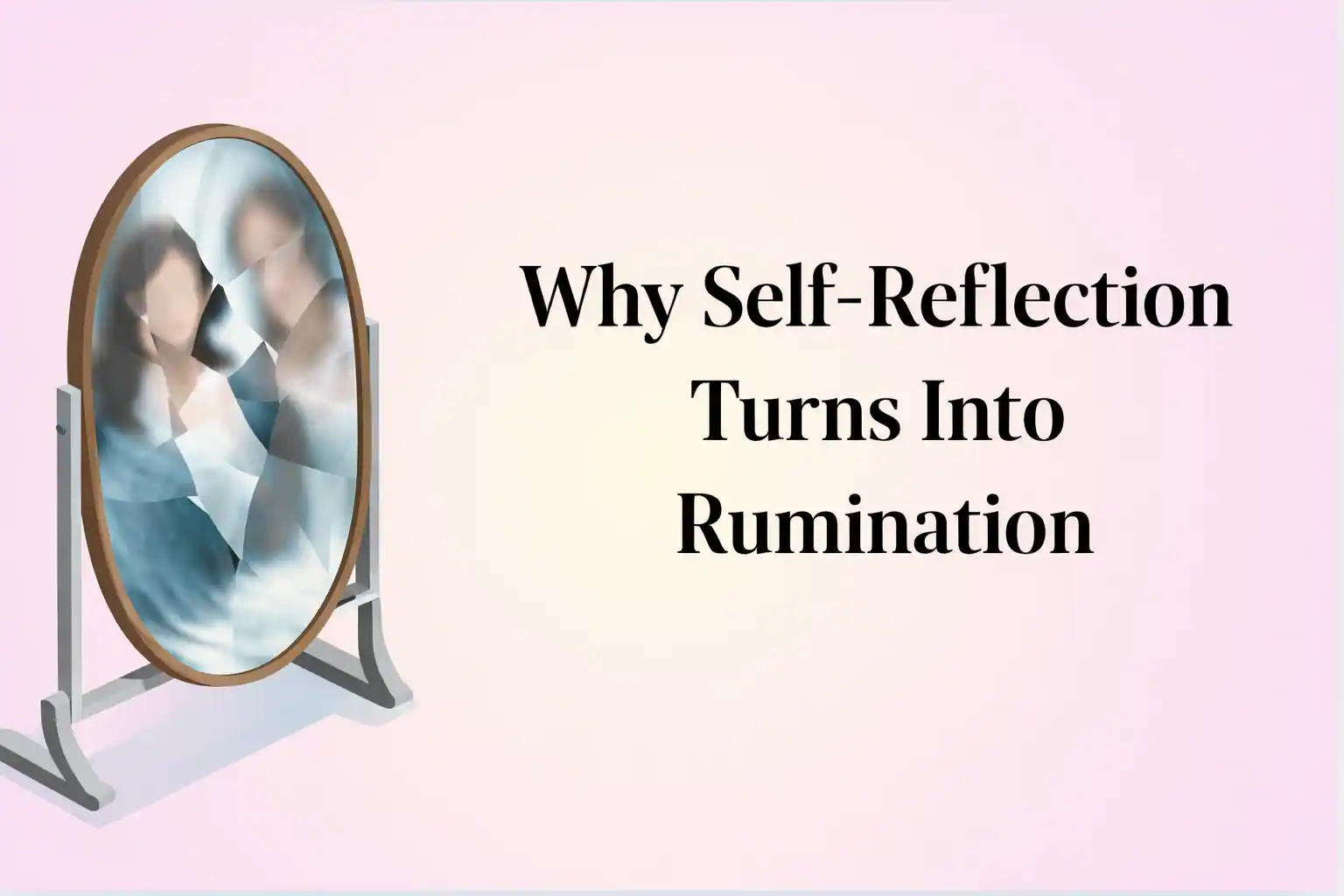
Self-reflection is often described as a healthy habit. It helps people learn from experiences, understand emotions, and make better decisions. But for many, self-reflection doesn’t stay constructive for long. Instead, it quietly turns into repetitive overthinking, self-criticism, and mental loops that feel impossible to escape.
This is where many people begin to ask why self-reflection turns into rumination, even when the intention is growth. Psychology offers a clear explanation: reflection and rumination are not the same process, even though they can look similar on the surface. The difference lies in how the mind relates to thoughts, emotions, and unresolved experiences.
Understanding this difference is the first step toward stopping unproductive mental loops without giving up self-awareness altogether.
Table of Contents
Self-Reflection vs Rumination: What’s the Difference?
Self-reflection is an adaptive cognitive process. It involves looking inward with curiosity, perspective, and a goal of learning. When people reflect, they ask questions like “What can I take from this?” or “What might I do differently next time?” Reflection is forward-moving and often leads to insight or emotional clarity.
Rumination, by contrast, is maladaptive. It is repetitive, passive, and emotionally charged. Instead of learning, the mind circles the same thoughts without resolution. Research distinguishes rumination as a pattern of brooding, a mental comparison between the present and an imagined “ideal” that was never achieved.
Psychology research has consistently shown that rumination is associated with higher levels of anxiety and depression, while reflection is linked to emotional intelligence and resilience. The challenge is that the two can feel almost identical internally, especially during stress.
This is why self-reflection turns into rumination so easily when emotional regulation is low or when unresolved experiences are activated.
Why the Shift Happens So Easily
The transition from reflection to rumination rarely feels intentional. It usually begins with stress, vulnerability, or emotional fatigue.
When people are tired, anxious, or emotionally overwhelmed, the brain’s threat-detection systems become more active. Instead of engaging the prefrontal cortex responsible for reasoning and perspectivemthe mind shifts toward survival-oriented processing. This makes reflective thinking less analytical and more self-critical.
Neuroscience research suggests that rumination strengthens neural pathways associated with negative bias. Each repeated loop reinforces the habit, making the mind more likely to return to the same thought pattern in the future. Over time, rumination becomes automatic rather than deliberate.
This explains why people often say, “I don’t mean to overthink it just happens.”
The Role of Regret, Trauma, and Unresolved Stress
Reflection is most likely to become ruminative when it is tied to unresolved emotional material. Regret, shame, or past experiences that never reached closure can anchor the mind in the past.
Trauma research shows that when experiences are not fully processed, the brain continues to revisit them in an attempt to regain control or understanding. Unfortunately, rumination does not resolve these experiences. It simply replays them.
Attachment styles also play a role. People with anxious attachment patterns may ruminate to seek reassurance or certainty, while avoidant patterns may suppress reflection until it resurfaces as intrusive overthinking later.
In all cases, rumination is less about insight and more about emotional overload.
Why Self-Reflection Turns Into Rumination : How Rumination Becomes a Habit
One of the most important insights from cognitive psychology is that rumination is reinforced through repetition. Each time the mind returns to the same thought, the neural pathway strengthens.
This is why people often notice that rumination appears during similar moments: late at night, after conflict, or during periods of uncertainty. The brain learns that these contexts trigger looping, and it responds automatically.
This habit formation is one reason why telling yourself to “just stop thinking” rarely works. Stopping rumination requires redirection and regulation, not suppression.
How to Stop Rumination Without Giving Up Self-Reflection
The goal is not to eliminate self-reflection. It is to prevent reflection from becoming unproductive.
1. Learn to Recognize the Shift
The earliest sign that reflection is turning into rumination is often physical rather than mental. Muscle tension, shallow breathing, or a tight chest can signal that thinking has moved from curiosity to threat.
Tracking these cues through journaling or brief check-ins can help you identify patterns. Awareness alone often reduces the intensity of rumination.
2. Use Mindfulness to Interrupt Mental Loops
Mindfulness does not mean forcing the mind to be quiet. It means redirecting attention to the present moment.
Research published through NIH-indexed studies shows that even brief mindfulness or distraction interventions can help interrupt ruminative states. By shifting attention away from self-focused thought, the brain exits the loop long enough to reset.
This is why practices like walking, breath awareness, or sensory grounding are effective, not because they solve the problem, but because they interrupt the habit.
For a deeper, evidence-based explanation of why rumination persists and how it can be interrupted, Psychology Today outlines practical techniques for reducing ruminative thinking .
3. Replace Rumination With Action-Oriented Reflection
One of the most important differences between healthy self-reflection and rumination is movement. Reflection leads somewhere. Rumination circles endlessly.
When people ask “why do I overthink my feelings?”, what they’re often experiencing isn’t a lack of insight, but a mind stuck replaying emotions without direction. Overthinking tends to show up when feelings are intense but unresolved, and the brain keeps returning to them in an attempt to gain control or certainty.
The shift happens when reflection moves from replaying emotions to responding to them. Instead of asking questions that pull you deeper into the past, Why did I feel this way? What does it say about me? action-oriented reflection gently redirects attention toward the present and the next step. This doesn’t mean suppressing emotions. It means giving them a path forward. Helpful reflection sounds like:
- What do I need right now to feel steadier?
- What would help me understand this feeling without judging it?
- What small action would create relief or clarity?
Rumination, by contrast, keeps the emotional system activated without resolution. Over time, this reinforces overthinking as a habit rather than a tool for understanding.
Research summarized by Healthline shows that shifting from “why” questions to action-oriented thinking helps the brain exit emotional loops and re-engage problem-solving systems.
4. Practice Self-Compassion, Not Self-Correction
Overthinking rarely comes from being careless or emotionally unaware. More often, it comes from caring deeply and wanting to get things right.
When people ask “why do I overthink my feelings?”, the answer is often rooted in how harshly they judge themselves for having those feelings in the first place. Rumination tends to carry an internal tone of self-correction: I shouldn’t feel this way. I should be over this by now. What’s wrong with me? Self-compassion shifts that tone.
Rather than trying to fix or silence emotions, self-compassion allows them to exist without immediate judgment. Research consistently shows that people who treat themselves with understanding rather than criticism experience less rumination and greater emotional resilience over time.
Seeing mistakes, confusion, or emotional reactions as part of being human changes how the brain processes reflection. Instead of looping through self-blame, the mind becomes more open to learning and integration.
5. Set Boundaries Around Reflection
One reason overthinking becomes exhausting is that reflection has no clear end point. Thoughts spill into every quiet moment, making it feel impossible to rest.
Cognitive and behavioral research suggests that containment, not avoidance, is key here. Setting gentle boundaries around reflection helps the mind feel safe enough to let go.
This might look like giving yourself a specific window to think something through, write about it, or process it consciously. Outside of that space, redirecting attention isn’t denial but emotional regulation.
For those who often wonder “why do I overthink my feelings all day?”, the issue isn’t too much awareness, but too little structure. When reflection has limits, the brain learns that it doesn’t need to stay on constant alert to be heard.
6. Understand When Professional Support Helps
Sometimes, overthinking is a signal.
If rumination feels persistent, overwhelming, or tied to past trauma, anxiety, or depression, support from a trained professional can make a meaningful difference. This doesn’t mean something is “wrong” with you. It means your nervous system may need guidance to relearn safety.
Research shows that even brief, focused interventions such as mindfulness-based approaches or cognitive restructuring can significantly reduce ruminative patterns, especially when overthinking has become automatic.
For many people asking “why do I overthink my feelings no matter what I do?”, the answer isn’t more effort, but the right kind of support. Having someone help you gently interrupt these cycles can create relief faster than trying to reason your way out alone.

The Benefits of Breaking the Cycle
Reducing rumination has measurable benefits. Studies link lower rumination to improved mood, better decision-making, and greater emotional flexibility.
When self-reflection stays adaptive, it supports growth rather than draining energy. Over time, consistent regulation rewires the brain toward healthier thinking patterns, a process supported by neuroplasticity research.
Final Thoughts
Understanding why self-reflection turns into rumination removes the shame many people feel about overthinking. Rumination is not a flaw or lack of discipline, it is a learned response to stress and unresolved emotion.
The goal is not to think less, but to think differently. When reflection is guided by curiosity, compassion, and regulation, it becomes a tool for clarity rather than a trap.
Stopping rumination does not mean abandoning self-awareness. It means learning how to use it without getting stuck.
If rumination is feeding anxiety in your day-to-day life, you’ll find this helpful: 10 Coping Skills for Anxiety .
FAQs
What is reflective rumination?
Reflective rumination refers to repetitive thinking that starts as self-reflection but becomes stuck on emotions or past events without leading to resolution. While it feels like problem-solving, it often keeps the mind looping rather than moving forward.
What is the difference between introspection and rumination?
Introspection is purposeful and curious, helping you gain insight or understanding. Rumination is repetitive and emotionally charged, focusing on what went wrong without offering clarity or direction. The key difference is whether the thinking leads to growth or keeps you mentally stuck.
What is the root cause of rumination?
Rumination often stems from emotional overwhelm, unresolved stress, or a need for certainty and control. It can also be reinforced by anxiety, perfectionism, or past experiences where emotions were not fully processed.

2 thoughts on “Why Self-Reflection Turns Into Rumination (And 6 Way On How to Stop)”