
Why does healing feel uncomfortable is a question many people ask when emotional work brings more intensity instead of relief. Therapy, self-reflection, or intentional healing practices are often approached with hope for calm and clarity. Instead, what arrives first can be exhaustion, emotional rawness, irritability, or a sense that things are unraveling rather than improving.
This experience is not a personal failure, nor is it a sign that healing is going wrong. Psychology and neuroscience show that discomfort is often the first visible sign that healing has actually begun.
Healing disrupts what was previously held together by avoidance. And disruption, by nature, does not feel gentle at the start.
Table of Contents
Why Healing Often Feels Worse Before It Feels Better
One of the most common misconceptions about emotional healing is that progress should feel immediately soothing. In reality, healing removes the coping strategies that once kept difficult emotions out of awareness.
For years, many people manage pain through distraction, suppression, or emotional distancing. These strategies reduce discomfort in the short term, but they also prevent emotional processing. When healing begins, these defenses loosen, and what was buried starts to surface.
This is why healing feels painful at first. The pain is not new; it was postponed. Healing simply brings it into conscious awareness.
Surfacing Suppressed Emotions
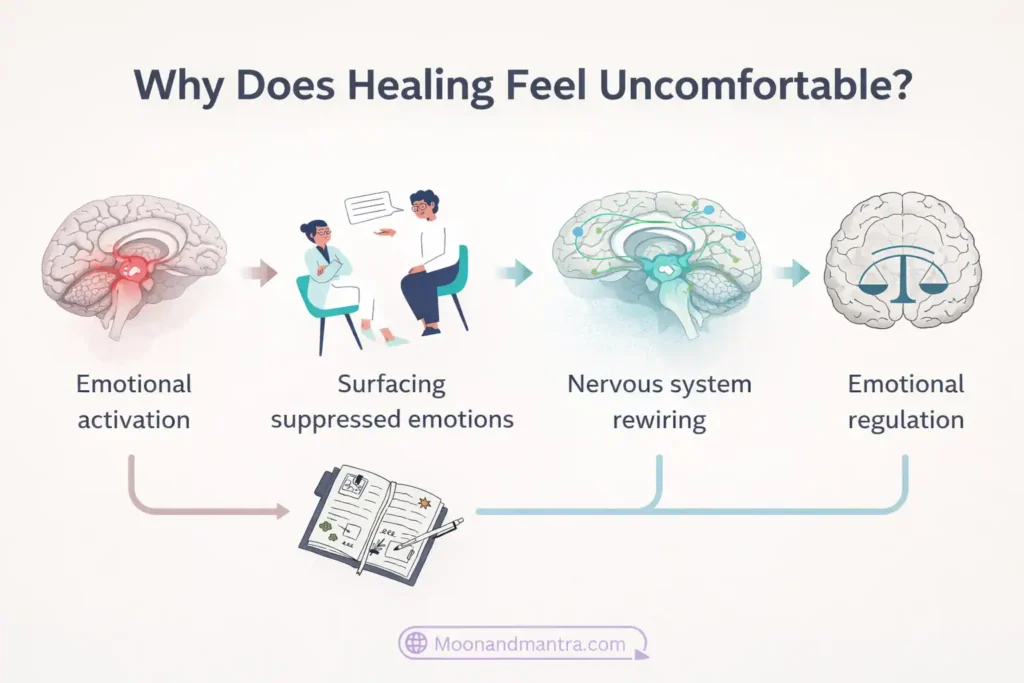
Emotions that are avoided do not disappear. They remain stored as unprocessed experience. When avoidance stops, these emotions rise quickly, sometimes all at once. This can feel like:
- heightened anxiety
- unexpected sadness or grief
- emotional sensitivity
- irritability without a clear cause
Psychologists often describe this as an emotional “thaw.” Like a frozen limb regaining circulation, sensation returns before comfort does. The initial discomfort is part of reactivation, not deterioration. Uncomfortable healing begins when emotions are finally allowed to be felt rather than managed.
Why Defenses Must Break Down
Emotional defenses exist to protect. Avoidance, suppression, and intellectualization often form during periods when feeling fully was unsafe or overwhelming.
In therapy and psychological healing, these defenses gradually weaken. Sigmund Freud referred to this phenomenon as the negative therapeutic reaction, where improvement temporarily worsens symptoms as deeper material emerges.
This explains why does healing feel uncomfortable even when you are doing the “right” things. The discomfort signals that defenses are no longer blocking emotional access. What once stayed hidden is now being processed.
🌿 If discomfort shows up as constant mental looping, this may help: How To Stop Overthinking A Lot Without Suppressing Feelings
Healing Is Not Linear
Healing does not move in a straight line. It moves in cycles. Old emotional material is revisited repeatedly, each time with more awareness, safety, or understanding. Early stages feel chaotic because multiple layers are being unpacked simultaneously.
This spiral pattern explains why healing feels painful at first. The nervous system is adjusting to new information, new emotional responses, and new levels of awareness all at once. Progress may look messy before it looks coherent.
Trauma Recovery and Emotional Flooding
In trauma recovery, discomfort can feel especially intense. When safety is established, emotions that were once suppressed for survival begin to surface rapidly.
Anger, fear, or grief may appear with a force that feels disproportionate to the present moment. This does not mean healing is retraumatizing. It means the nervous system is releasing stored responses that were never processed.
Trauma recovery often feels worse before it improves because the body is learning that it no longer needs to stay numb or hypervigilant.
The Neurobiology of Uncomfortable Healing
Neuroscience helps explain why does healing feel uncomfortable on a physical level. When emotional healing begins:
- the amygdala reduces threat-based responses
- the prefrontal cortex increases regulation and reflection
- stress hormones stored in the body are released
This rewiring process consumes significant energy. Emotional processing is metabolically demanding, often resulting in fatigue, brain fog, or physical tension.
Uncomfortable healing is not just psychological. It is biological adaptation.
The Concept of a Healing Crisis
Some psychologists describe this phase as a healing crisis. This refers to a temporary worsening of symptoms as the mind and body reorganize. A healing crisis may involve:
- emotional swings
- exhaustion
- resurfacing memories
- heightened sensitivity
Importantly, this phase is time-limited. It reflects transition, not collapse. The system is recalibrating, not breaking. Understanding this concept helps answer why healing feels painful at first without pathologizing the experience.
Why People Mistake Discomfort for Failure
Because discomfort is unpleasant, many people interpret it as evidence that something is wrong. This leads to premature quitting of therapy or emotional work.
Research shows that a significant number of people consider stopping therapy during early stages due to increased discomfort. Yet those who continue often experience deeper breakthroughs once integration begins.
Healing feels uncomfortable precisely because it is interrupting old patterns. Comfort often returns only after reorganization occurs.
Why Discomfort Is a Sign of Progress
Progress in emotional healing is not measured by ease. It is measured by capacity. When difficult emotions can be felt without avoidance, the nervous system is expanding its tolerance. This increased tolerance leads to resilience, emotional flexibility, and long-term stability.
Uncomfortable healing signals engagement. Avoidance signals stagnation.
How to Navigate the Discomfort Without Overwhelm
Discomfort does not need to be endured without support. Helpful approaches include:
- Pacing: Healing does not require intensity all the time. Slowing down aids integration.
- Regulation: Gentle grounding practices help process emotions safely.
- Context: Knowing why does healing feel uncomfortable reduces fear and self-judgment.
- Support: Professional or relational support helps normalize the experience.
The goal is not to rush relief, but to allow regulation to catch up with awareness.
Healing as Integration, Not Elimination
Healing does not erase painful experiences. It integrates them. Memories lose their emotional charge not because they disappear, but because they are no longer avoided.
Over time, emotional reactions soften, and patterns lose their grip. What once felt overwhelming becomes informative.
Why Healing Eventually Feels Better
Once the nervous system completes its initial reorganization, emotional stability increases. Clarity replaces confusion. Emotional responses feel more proportional and manageable.
This is the stage people often mistake for sudden improvement. In reality, it is the delayed result of earlier uncomfortable healing doing its work.
A Research-Based Perspective
For a scientific explanation of how emotional processing affects the body during healing, this article offers a grounded overview:
The Body’s Role in Emotional Healing
https://www.psychologytoday.com/us/blog/somatic-psychology/202505/the-bodys-role-in-emotional-healing
Final Reflection
If you are asking why does healing feel uncomfortable, it may be because healing has moved from avoidance to engagement. Discomfort is not the destination. It is the passage between suppression and integration.
Why healing feels painful at first is not a mystery of weakness. It is a predictable phase of real psychological change.
Uncomfortable healing is not a sign to stop. It is often a sign that something important is finally shifting.
FAQs
Why does emotional healing hurt?
Emotional healing can hurt because it brings suppressed feelings into awareness. Processing emotions that were previously avoided often creates temporary discomfort before relief and integration occur.
Does crying release trauma?
Crying can help release emotional tension and regulate the nervous system, but trauma healing usually involves multiple processes beyond emotional expression alone.
How does emotional healing feel like?
Emotional healing often feels uneven at first, marked by sensitivity, fatigue, or emotional clarity, before gradually leading to greater stability and emotional balance.

2 thoughts on “Why Does Healing Feel Uncomfortable? The Science Behind Why It Feels Painful at 1st”