
Motivation is often treated as the starting point for personal growth. People look for energy, discipline, or inspiration to change their habits. Yet this focus misses a deeper question: why is self awareness important in the first place?
Self-awareness determines how clearly you understand your thoughts, emotions, and patterns. Without it, motivation tends to be reactive and short-lived. You may feel driven one day and disconnected the next, without knowing why. This is why many people struggle even when they feel motivated.
So why does self awareness matter more than motivation? Because awareness shapes how you interpret experiences, respond to challenges, and repeat behaviours over time. Motivation pushes action, but self-awareness guides direction.
In this article, we explore why self-awareness is harder to build than motivation, why it is often overlooked, and what you can do to improve self awareness through practical habits and reflection rather than hype.
If you’re looking to build steadier emotional responses and better self-regulation, this will help you go deeper.
Read: 5 Best Books for Emotional RegulationTable of Contents
Why Motivation Feels Easier Than Self-Awareness
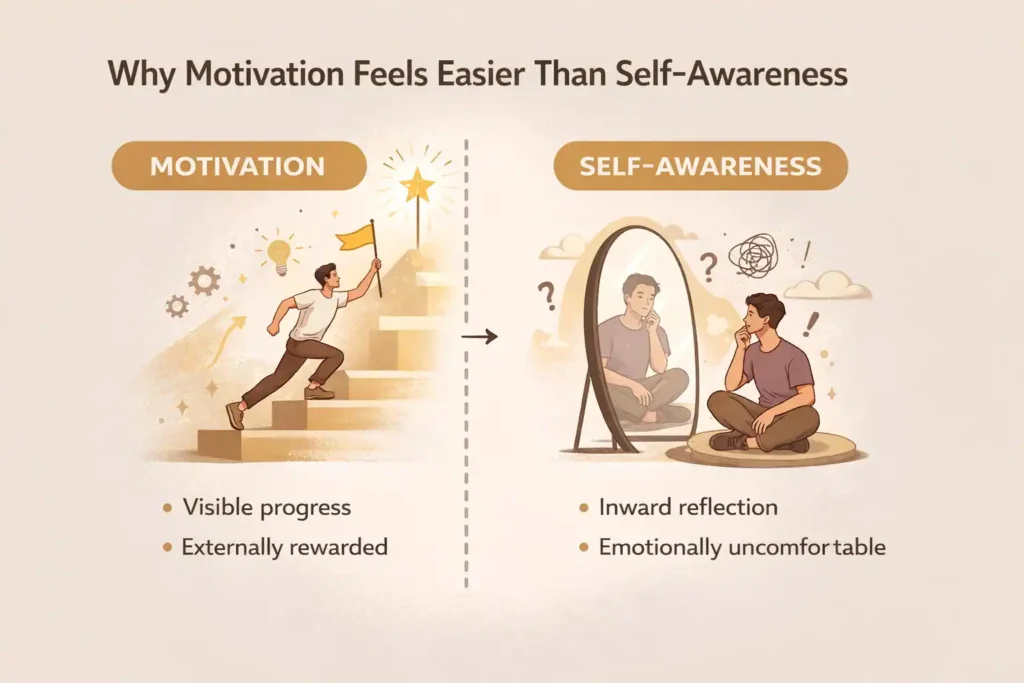
Motivation feels easier because it creates movement without asking many questions. When you feel motivated, you act. You start something new, set goals, or make plans. That action feels productive, even when it isn’t deeply informed. This is one reason people rarely pause to ask why is self awareness important when motivation already feels sufficient.
Self-awareness, on the other hand, doesn’t give instant momentum. It asks you to slow down and observe. Instead of doing more, it asks you to understand more. That shift is uncomfortable. It brings attention to patterns, emotional reactions, and habits that are usually ignored. This discomfort explains why does self awareness matter less to people in the beginning, even though it plays a bigger role in long-term growth.
Another reason motivation feels easier is because it is externally rewarded. Visible effort is praised. Starting something new looks impressive. Self-awareness is internal and often invisible. No one applauds noticing your own triggers or recognising why you repeat the same mistakes. Yet these moments of insight are exactly why self awareness is important beyond surface-level change.
Motivation also offers emotional relief. It creates the feeling that change is already happening. Self-awareness does the opposite. It removes comfort by showing you what hasn’t been working. That honesty can feel discouraging at first, which is why many people avoid it and return to motivation whenever progress stalls. This cycle hides the real answer to why does self awareness matter more than motivation alone.
Over time, relying only on motivation leads to repeated starts and stops. People assume they lack discipline, when in reality they lack clarity. Self-awareness provides that clarity. It explains why motivation fades and why effort doesn’t always lead to results. This is the deeper reason why is self awareness important if growth is meant to last, not just begin.
Why Self-Awareness Is Harder (But More Powerful)
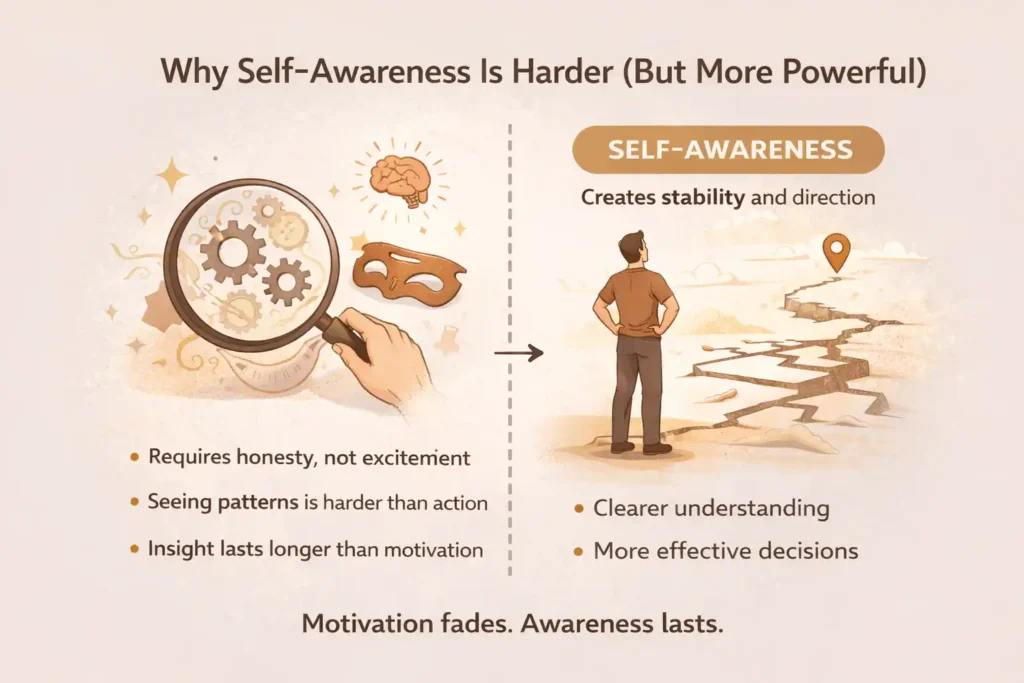
Self-awareness is harder than motivation because it requires honesty rather than excitement. Motivation feeds on energy, plans, and optimism. Self-awareness asks you to look at what is actually happening, including the parts you might prefer to ignore. It involves noticing emotional reactions, defensive habits, and repeated patterns without immediately trying to fix or justify them. This level of honesty is uncomfortable, which is exactly why many people avoid it.
Another reason self-awareness feels difficult is that seeing patterns is harder than taking action. Action gives the mind something to do. Awareness asks the mind to observe instead. It means recognising why the same situations trigger frustration, why certain goals keep changing, or why motivation disappears after a strong start. This observation phase can feel slow and unproductive, even though it is doing the most important work. Understanding these patterns is a key answer to why is self awareness important beyond surface-level self-improvement.
Insight also lasts longer than motivation. Motivation rises and falls with mood, environment, and circumstances. Insight, once gained, stays with you. When you clearly see how you respond under stress or why you repeat certain behaviours, that understanding doesn’t vanish when motivation dips. This is why people who build awareness rely less on willpower and more on clarity. Over time, they need fewer restarts because they understand themselves better.
This is also where many people ask practical questions like what can you do to improve self awareness or ways to practice self awareness without turning it into another task to optimise. The answer is not to force reflection or overanalyse every thought. It is to build the capacity to notice what is happening internally before reacting. That noticing creates space. In that space, better choices become possible without needing constant motivation.
Ultimately, this is why self awareness matters more than motivation. Motivation pushes you forward, but awareness tells you where you’re actually standing. Without awareness, effort is often misdirected. With awareness, even small actions become more effective. Self-awareness may be harder to build, but it creates stability, continuity, and direction in ways motivation alone never can.
Self-Awareness Habits That Actually Build Insight
Self-awareness doesn’t develop through big realisations or occasional deep thinking. It grows through small, repeatable habits that create clarity over time. This is where many people go wrong. They assume awareness comes from intense reflection, when in reality it comes from consistency. That’s exactly why does self awareness matter at the habit level, not just as an idea.
Daily self awareness habits (simple, not heavy)
Daily self awareness habits work best when they are light enough to sustain. The goal is not to analyse everything, but to notice a little more each day.
A few practical examples:
- Pausing briefly before reacting in emotionally charged moments
- Noting one recurring emotional pattern at the end of the day
- Asking yourself what influenced a decision rather than judging it
These habits don’t require journaling for hours or fixing anything immediately. They build familiarity with your inner responses, which is a key reason why does self awareness matter in everyday life. Awareness precedes change.
Weekly habits that deepen insight
Weekly self awareness habits help connect the dots. Instead of focusing on isolated moments, they help you see patterns across time.
Once a week, reflect on:
- Situations that drained or energised you
- Reactions you had more than once
- Decisions that felt aligned versus forced
This kind of review answers what you can do to improve self awareness without overwhelming yourself. You’re not searching for solutions yet. You’re simply collecting information about how you operate.
Reflection vs rumination (this matters)
One of the biggest obstacles to building self awareness habits is confusing reflection with rumination.
- Reflection observes without blame.
- Rumination loops with judgement and emotional intensity.
If a habit leaves you feeling stuck or mentally exhausted, it’s likely rumination. Effective self awareness habits feel clarifying, even when the insight is uncomfortable. This distinction is crucial in understanding why does self awareness matter for mental and emotional stability, not just self-improvement.
Ways to practice self awareness without overwhelm
The most sustainable ways to practice self awareness are grounded and limited in scope. You don’t need to observe everything at once. Pick one lens at a time.
For example:
- Observe only emotional triggers this week
- Notice only decision-making patterns next week
- Focus only on energy levels another week
This approach prevents overload and keeps awareness practical. It also answers what you can do to improve self awareness in a way that fits into real life, not an idealised routine.
Self-awareness grows when habits are gentle but consistent. These habits may not feel dramatic, but over time they change how you respond, decide, and adapt. That quiet shift is the real reason why does self awareness matter far more than momentary motivation or insight alone.
What am I feeling? What triggered it? What do I need?
“I get tense when… / I feel confident when… / I procrastinate when…”
Reflection ends in a next step. Rumination ends in self-blame.
Facts, assumptions, what you avoided, what you’ll do differently.
Ask: “One thing I do well, one thing I don’t notice about myself?”
What Changes When Self-Awareness Becomes a Habit
When self-awareness becomes a habit, change doesn’t announce itself loudly. There are no dramatic breakthroughs or sudden personality shifts. Instead, small internal adjustments begin to shape how you think, decide, and respond. This quiet shift is often overlooked, even though it explains why is self awareness important in the long run.
One of the first changes people notice is in decision-making. Choices start feeling less impulsive and more deliberate. You pause before agreeing, reacting, or committing. This pause isn’t hesitation, it’s clarity. You begin to recognise emotional influence in decisions and account for it, rather than being driven by it. This is one of the most practical ways to practice self awareness without adding effort. Awareness simply inserts space between stimulus and response.
Another change shows up as emotional steadiness, not emotional control. Self-awareness doesn’t suppress feelings or force positivity. Instead, it allows emotions to exist without immediately acting on them. You still feel frustration, disappointment, or excitement, but those emotions no longer dictate behaviour as strongly. This distinction matters because emotional steadiness comes from understanding patterns, not managing reactions tightly.
Boundaries also become clearer. As awareness grows, you start noticing where you consistently overextend, avoid conflict, or repeat the same relational patterns. With that insight, boundaries form naturally. You say no earlier. You disengage sooner. You stop explaining yourself excessively. These shifts don’t feel like self-improvement tactics; they feel like alignment. This is another reason why is self awareness important beyond productivity or motivation.
Perhaps the most unexpected change is that growth begins to feel quieter. There is less urgency to constantly improve or reinvent yourself. Progress feels internal before it becomes visible. You trust your pace more. You rely less on external validation or motivation because clarity is already doing the work. This quieter growth is often more stable and sustainable than change driven by excitement alone.
In the end, self-awareness doesn’t transform life overnight. It transforms how you move through it. That transformation is subtle, steady, and real. And that is exactly why is self awareness important when the goal is long-term clarity rather than short-term momentum.
Research published by Harvard Business Review shows that self-awareness improves decision-making, emotional regulation, and leadership effectiveness over time. It also highlights that true self-awareness comes from reflection and feedback, not constant self-analysis.
FAQs
Why is self-awareness important?
Self-awareness is important because it helps you understand your thoughts, emotions, and patterns before they shape your decisions. It creates clarity, reduces repeated mistakes, and supports more intentional choices over time.
What causes a lack of self-awareness?
A lack of self-awareness is often caused by constant distraction, emotional avoidance, and moving too quickly from feeling to action. Without pauses for reflection, patterns remain unnoticed and repeat automatically.
Why is self perception important?
Self perception is important because how you see yourself influences how you respond to feedback, relationships, and challenges. Accurate self perception allows growth, while distorted self perception often leads to defensiveness or self-doubt.
2 thoughts on “Why Is Self Awareness Important (And Why Motivation Alone Is Never Enough)”