
Most people breathe automatically, without ever thinking about how it affects their body or mind. But research now shows why conscious breathing is important for health, especially in a world where stress, anxiety, and constant mental stimulation keep the nervous system on edge.
Conscious breathing is not about forcing calm or doing complicated techniques. It’s about using intentional breath patterns to influence how your brain and body respond to pressure. From regulating stress hormones to improving emotional balance, even a few minutes of mindful breathing each day can create measurable changes in how you feel and function.
Table of Contents
Why Conscious Breathing Is Important for Health
To understand why conscious breathing is important for health, researchers often begin with how breathing directly interacts with the autonomic nervous system. Unlike most bodily functions, breathing can be both automatic and intentional, which is why psychologists and neuroscientists frequently describe it as a “gateway” between mental states and physiological responses.
Multiple systematic reviews and meta-analyses published between 2023 and 2024 have shown that intentional breathing practices influence the balance between the sympathetic nervous system (associated with stress and alertness) and the parasympathetic nervous system (associated with rest and recovery). Research groups studying stress physiology note that modern lifestyles keep many people in a prolonged state of sympathetic activation, even in the absence of immediate threats.
According to findings summarized in journals covering behavioral medicine and psychophysiology, slow and conscious breathing patterns send feedback signals to the brain that reduce physiological arousal. These signals are closely linked to increased heart rate variability, a marker widely used in clinical and research settings to assess nervous system flexibility and emotional resilience. Institutions studying stress-related disorders consistently highlight this mechanism as one reason breathing practices are effective across both mental and physical health domains.
Researchers also emphasize that conscious breathing does not function as a cure or a replacement for therapy. Instead, it is described as a low-cost, low-risk regulatory tool that supports the body’s natural ability to return to baseline after stress. This framing appears repeatedly in randomized controlled trials examining breathing interventions for stress, anxiety, and emotional regulation.
From this research perspective, why conscious breathing is important for health becomes clearer. It works not by suppressing stress, but by restoring balance to systems that are already designed to self-regulate. This is why scientists studying emotional health increasingly view breathing practices as a foundational skill rather than a niche relaxation technique.
Findings discussed here are supported by a 2023 peer-reviewed study published in Cell Reports Medicine by researchers at Stanford University, which examined how short, structured breathing practices influence mood and physiological stress responses. Read the study
How Conscious Breathing Affects the Nervous System
Research into how conscious breathing affects the nervous system focuses largely on the autonomic nervous system, which regulates functions such as heart rate, digestion, and stress responses without conscious effort. This system has two main branches: the sympathetic nervous system, responsible for fight-or-flight reactions, and the parasympathetic nervous system, which supports rest, recovery, and emotional regulation.
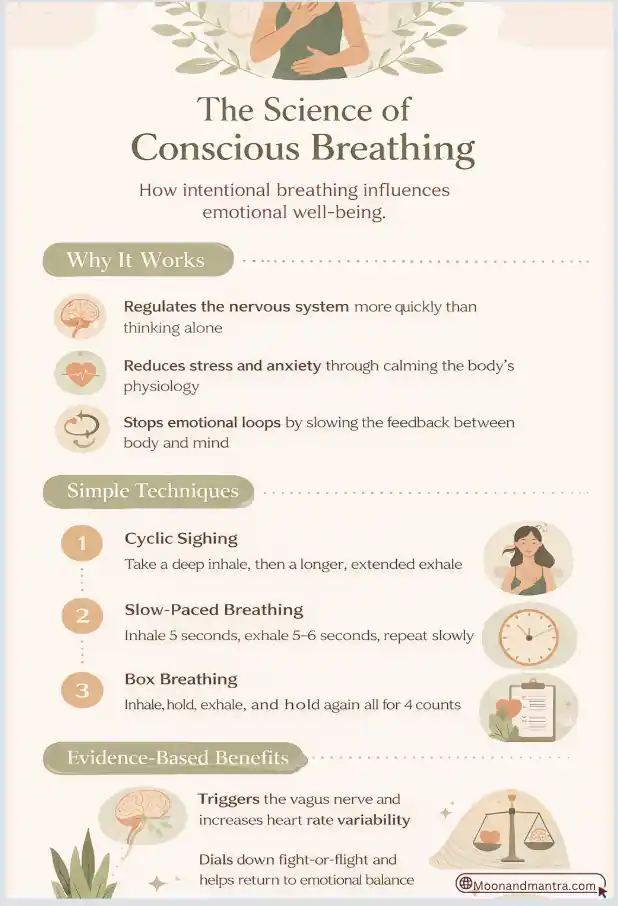
Studies in psychophysiology and behavioral medicine consistently show that slow, intentional breathing increases parasympathetic activity. This shift is commonly measured through changes in heart rate variability, or HRV, a marker widely used in clinical and research settings to assess how flexibly the nervous system adapts to stress. Higher HRV is associated with better emotional regulation, resilience, and cardiovascular health, while lower HRV is often linked to chronic stress and anxiety.
The vagus nerve plays a central role in this process. Researchers studying the vagal pathways describe breathing as a mechanical and neurological signal that influences how quickly the body can move out of a stress response. Slow breathing, particularly when the exhale is slightly longer than the inhale, stimulates vagal activity, sending feedback to the brain that reduces physiological arousal. This mechanism has been highlighted in multiple randomized controlled trials examining breathing-based interventions for stress and anxiety.
What distinguishes breathing from many other self-regulation techniques is its immediacy. Because respiration directly affects blood chemistry and neural signaling, changes in breathing patterns can alter nervous system activity within minutes. This helps explain why research reviews often note that breathing practices reduce physiological stress markers faster than purely cognitive strategies.
From this scientific perspective, understanding how conscious breathing affects the nervous system clarifies why it is increasingly recommended as a foundational regulation tool. Rather than suppressing stress, slow and intentional breathing works by restoring balance between activation and recovery, allowing the nervous system to return to a more stable baseline after periods of strain.
Benefits of Conscious Breathing for Stress and Anxiety
Much of the scientific interest in breathing practices comes from their role in stress reduction. When researchers examine the benefits of conscious breathing, they often focus on how intentional breath patterns influence anxiety, emotional reactivity, and physiological arousal rather than eliminating stress altogether.
Multiple randomized controlled trials and meta-analyses published in recent years suggest that conscious breathing for stress and anxiety produces small to moderate short-term improvements in perceived stress levels. These effects are most consistently observed in reduced nervous system arousal, such as slower heart rate, calmer breathing rhythms, and improved emotional steadiness. Researchers emphasize that these changes are measurable within minutes, making breathing practices particularly useful during moments of acute stress.
At the same time, research is careful not to overstate long-term outcomes. Reviews comparing breathing interventions with mindfulness or relaxation practices often note that while conscious breathing improves mood and anxiety symptoms, its effects tend to be strongest in the short term. Long-term benefits appear when breathing is practiced consistently and combined with broader lifestyle or therapeutic support. This distinction is important, as studies repeatedly caution against viewing breathing techniques as standalone solutions for chronic anxiety disorders.
What makes conscious breathing for stress and anxiety especially relevant is its impact on emotional reactivity. Research in affect regulation shows that slow breathing can reduce the intensity of emotional responses, allowing individuals to respond rather than react. This helps explain why breathing exercises are frequently included in evidence-based treatments for anxiety, panic, and stress-related conditions as a supporting skill rather than a primary intervention.
Overall, studies suggest that conscious breathing works best as a stabilizing tool. It does not remove stress from daily life, but it improves the nervous system’s ability to handle stress without becoming overwhelmed. This balanced interpretation reflects how breathing practices are currently understood in psychological and behavioral health research.
Conscious Breathing and Emotional Regulation
Emotional regulation refers to the ability to experience emotions without becoming overwhelmed or trapped in repetitive mental loops. Research in psychology and neuroscience increasingly shows that breathing-based practices influence emotional flexibility more directly than cognitive strategies alone. This is why breathwork for emotional regulation has become a focus in both clinical research and therapeutic settings.
Studies examining slow-paced breathing, yogic breathing, and related practices often include forms of pranayama, though they are typically described using neutral terms such as “controlled breathing” or “paced respiration.” When pranayama techniques are studied in controlled settings, researchers attribute their effects to changes in autonomic nervous system activity rather than spiritual mechanisms. These studies consistently report reductions in emotional intensity, panic symptoms, and physiological markers of stress.
One reason breathing works so effectively during emotional overwhelm is speed. Emotional reactions such as panic or anxiety are driven by subcortical brain regions that respond faster than conscious thought. Cognitive approaches like reframing or reasoning require prefrontal cortex engagement, which can be difficult when the nervous system is highly activated. Breathing, by contrast, directly alters physiological signals sent to the brain, allowing emotional intensity to decrease before conscious processing resumes.
Research on emotional loops, including rumination and panic cycles, suggests that slow breathing interrupts the feedback loop between physical arousal and anxious thought. This creates a window in which emotions can be felt without escalating. For this reason, many therapeutic models now include breathwork for emotional regulation as a first-line grounding skill rather than a secondary technique.
From a scientific perspective, breathing practices do not eliminate emotions. Instead, they reduce the body’s reactivity so emotions can move through the system without becoming overwhelming. This explains why breathing-based regulation is often recommended before cognitive strategies, especially in moments of acute emotional stress.
Simple Ways to Practice Conscious Breathing Daily
Research consistently shows that short, intentional breathing practices can be effective even when done for just a few minutes a day. Most studies emphasize consistency over duration, making conscious breathing realistic to integrate into modern routines like workdays, commutes, or evening wind-down time.
One reason these practices work is tied to how conscious breathing affects the nervous system, particularly through slower respiratory rates that increase parasympathetic activity and reduce physiological stress signals. This means the body begins to settle before the mind fully catches up, which is why breathing techniques are often easier to apply than cognitive strategies in moments of overwhelm.
Here are a few evidence-supported approaches that are commonly studied:
Cyclic sighing
This involves a deep inhale through the nose followed by a slow, extended exhale through the mouth. Recent randomized controlled trials suggest that even five minutes of this pattern can improve mood and reduce acute stress more effectively than passive mindfulness exercises.
Slow-paced breathing
Breathing at roughly five to six breaths per minute, with equal emphasis on inhale and exhale, is widely used in heart-rate variability research. Studies link this pattern to improved emotional regulation and autonomic balance when practiced regularly.
Box breathing (with moderation)
Box breathing uses equal counts for inhale, hold, exhale, and hold. While helpful for focus and grounding, research suggests it may be better suited for short periods rather than extended practice, especially for people prone to anxiety.
Across studies, the benefits of conscious breathing appear strongest when these techniques are practiced briefly but consistently, without forcing intensity or perfection. The goal is not to control the breath aggressively, but to create a physiological environment where the body naturally shifts toward calm and regulation.
Conscious breathing works best when paired with emotional awareness. If you want to understand how your internal state shapes what you notice, react to, and attract, this deep dive explains the psychological and neurological link.
Read: How Your Emotional State Shapes What You Attract →
Why is conscious breathing important?
Conscious breathing is important because it directly influences the nervous system. Research shows that slow, intentional breathing helps reduce physiological stress responses, supports emotional regulation, and improves the body’s ability to return to a calm baseline after stress.
Why do I need to consciously breathe?
Most people breathe automatically in shallow patterns, especially under stress. Consciously breathing helps interrupt this pattern by signaling safety to the brain, which lowers emotional reactivity and supports better focus, mood stability, and stress recovery.
What is the science behind conscious breathing?
The science behind conscious breathing lies in its effect on the autonomic nervous system. Studies show that intentional breathing increases parasympathetic activity, improves heart rate variability, and reduces stress-related arousal by influencing vagal nerve signaling and brain–body feedback loops.