

Decisions rarely fail because of lack of intelligence. They falter because they are made too quickly, too emotionally, or too unconsciously.
This is where how awareness changes decision making becomes relevant. Awareness does not remove uncertainty, improve outcomes by force, or guarantee clarity. Instead, it alters the inner conditions under which a decision is made like the quality of attention, the emotional state involved, and the narratives influencing judgment in that moment.
When awareness is present, decisions tend to feel slower but more coherent. There is space to notice emotional pressure, habitual reactions, and external noise before acting on them. This doesn’t make choices perfect, but it often makes them more aligned, with values, context, and long-term consequences rather than short-term urgency.
This article explores the subtle but powerful ways awareness reshapes decision-making across everyday situations, not by predicting outcomes, but by changing how choices are experienced and understood.
Table of Contents
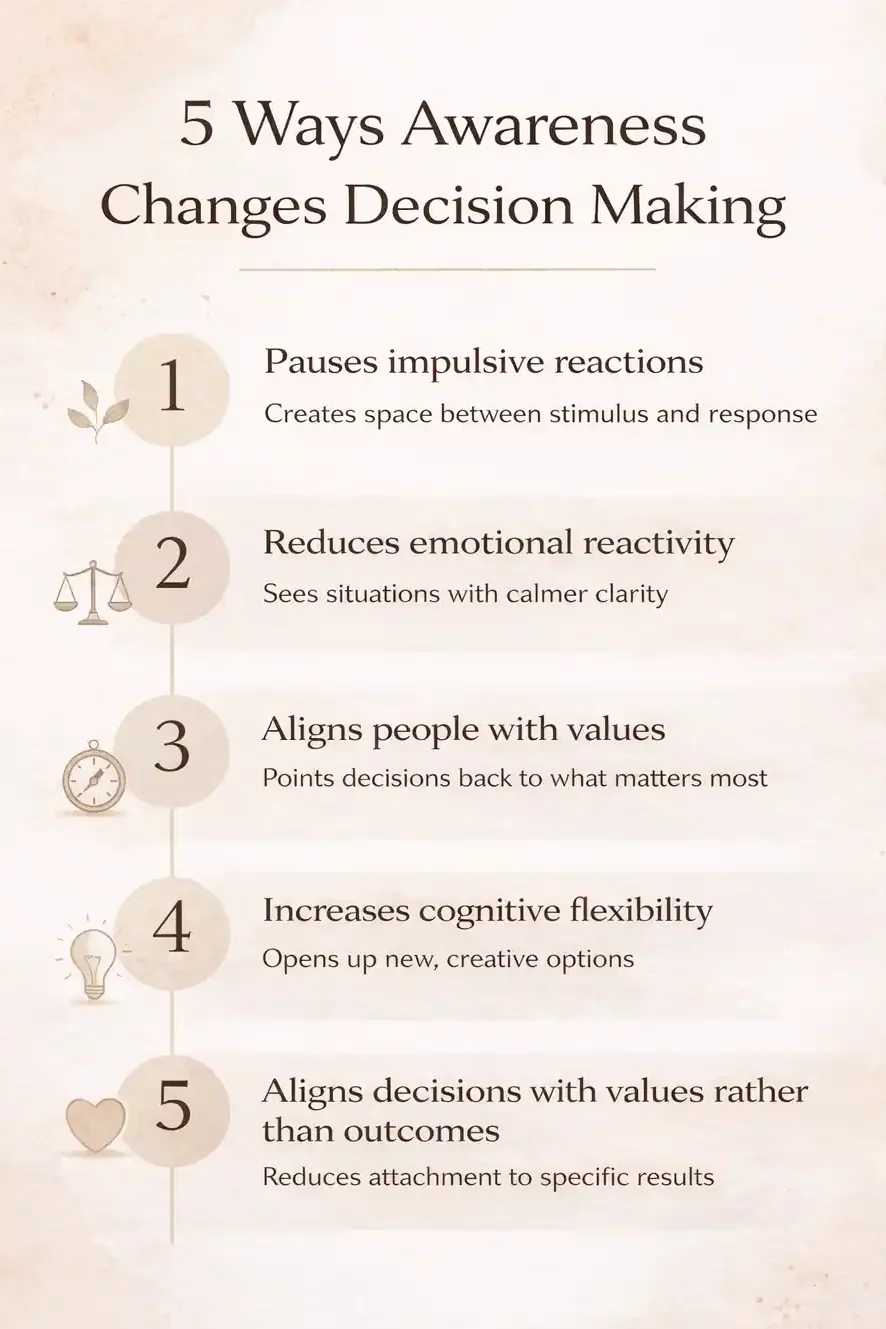
Awareness Shifts Decisions From Automatic to Deliberate
Most decisions are not made consciously. They are reactions shaped by habit, emotion, memory, and speed. What awareness changes in decision making is not the outcome first, but the process.
When awareness is present, the mind pauses just long enough to notice what it is about to do. That pause is subtle, but powerful. It creates distance between impulse and action, between stimulus and response. In the psychology of decision making, this shift marks the movement from automatic processing to deliberate choice.
Research in decision making psychology shows that awareness strengthens executive control the part of the brain responsible for attention, inhibition, and intentional action. In practical terms, this means fewer knee-jerk responses and more considered decisions. You begin to recognize patterns as they arise rather than after they have already played out.
This is why awareness and decision making are so closely linked. Awareness does not tell you what to choose. It changes how you choose. Instead of defaulting to familiar behaviors, emotional shortcuts, or learned reactions, conscious decision making becomes possible.
In daily life, awareness in daily decisions might look ordinary on the surface. Pausing before replying to a message. Noticing urgency without acting on it immediately. Choosing when to engage rather than reacting out of habit. These moments are small, but they accumulate.
Over time, this shift reshapes how choices feel. Decisions become less rushed, less reactive, and more aligned with intention. Not perfect. Just clearer. This is the foundation of how awareness changes decision making. Before values, emotions, or ethics come into play, awareness first restores choice itself.
Awareness Reduces Emotional Reactivity and Decision Bias
One of the most meaningful ways awareness changes decision making is by softening our emotional reflexes. Most poor choices aren’t caused by a lack of intelligence or information. They happen because emotions take the driver’s seat before reasoning has a chance to engage.
When awareness is present, emotions don’t disappear. They become visible. This visibility creates a pause and that pause is where conscious decision making begins.
In decision making psychology, this is critical. Emotional reactions such as fear, attachment, urgency, or overconfidence often fuel cognitive biases like confirmation bias, loss aversion, or the sunk cost fallacy. Without awareness, we act from these biases. With awareness, we can observe them without immediately obeying them.
Research in mindfulness and neuroscience shows that awareness-based practices reduce activity in brain regions linked to emotional reactivity, while strengthening areas responsible for evaluation and perspective-taking. Practically, this means fewer impulsive decisions and more balanced assessments, especially in emotionally charged situations.
In everyday life, awareness in daily decisions might look simple:
- Pausing before replying defensively
- Reconsidering a purchase driven by anxiety or comparison
- Letting go of a choice that no longer aligns, instead of clinging because of past effort
This shift matters because emotions are not the enemy of good decisions. They are valuable signals but only when they are integrated, not dominant.
As awareness and decision making strengthen together, choices become less reactive and more responsive. Instead of asking, “How do I feel right now?” the mind naturally moves toward, “What actually makes sense here?”
Awareness Improves Psychological Flexibility at Moments of Choice
Another powerful way awareness changes decision making is by increasing psychological flexibility, the ability to shift perspective, adapt to new information, and respond without getting stuck in rigid patterns.
Most decisions don’t fail because the options are wrong. They fail because the mind becomes attached to a single narrative: this is how it should be, this is who I am, or this is the only acceptable outcome. Awareness loosens that grip.
In decision making psychology, psychological flexibility is linked to better problem-solving, creativity, and long-term satisfaction. Awareness helps us notice when we’re operating on outdated assumptions or emotional scripts, making it easier to reassess rather than react.
From a neuroscience perspective, awareness-based practices strengthen cognitive flexibility the brain’s ability to switch strategies when circumstances change. This allows conscious decision making to remain fluid instead of defensive, especially during uncertainty or transition.
In real life, awareness in daily decisions often shows up as:
- Willingness to revise a plan when new facts emerge
- Letting go of a choice made out of identity or ego rather than relevance
- Exploring alternatives without feeling threatened by them
This flexibility is especially important at moments of change like career shifts, relationship crossroads, or periods of personal growth. Awareness creates mental space where multiple options can be held without urgency to resolve them immediately.
When awareness and decision making work together this way, choices become adaptive rather than habitual. The mind learns to respond to what is, not just repeat what was.
Awareness Refines Attention and Information Processing
A crucial way awareness changes decision making is through attention. Before a decision is emotional or strategic, it is perceptual. What we notice, what we ignore, and what we misinterpret all shape the outcome long before a choice is made.
Without awareness, attention is easily scattered. The mind jumps between stimuli, reacts to the loudest signal, or fixates on a single detail while missing the broader context. In decision making psychology, this fragmented attention often leads to incomplete evaluations and rushed conclusions.
Awareness refines this process by stabilizing attention. It helps the mind stay with what is relevant rather than what is urgent. Research suggests that awareness-based practices reduce mind-wandering and improve attentional control, allowing information to be processed more deliberately and in proper sequence.
This doesn’t mean taking in more information. It often means taking in less, but with greater clarity. Awareness filters noise. It highlights what actually matters to the decision at hand and gently sidelines distractions, comparisons, and internal commentary.
In everyday terms, awareness in daily decisions might look like:
- Reading information fully instead of skimming reactively
- Noticing when overwhelm is driving avoidance or snap judgments
- Allowing time for facts to settle before forming conclusions
As awareness and decision making align, choices feel less mentally exhausting. The mind is no longer pulled in multiple directions at once. Attention becomes an ally rather than a liability.
This refinement matters because decisions are rarely limited by intelligence. They are limited by attention. Awareness doesn’t speed the process up. It makes it cleaner.
Awareness Aligns Decisions With Values Rather Than Outcomes
Perhaps the most enduring way awareness changes decision making is by shifting the reference point. Instead of measuring choices primarily by outcomes, awareness brings attention back to values.
Outcomes are uncertain by nature. They depend on timing, external conditions, and factors beyond personal control. When decisions are made solely to secure a specific result, they often carry anxiety, attachment, and second-guessing. Awareness doesn’t remove this uncertainty, but it changes how it is held.
In decision making psychology, values act as internal anchors. Awareness helps make these anchors visible. It allows a person to notice whether a choice is being driven by fear, approval, habit, or genuine alignment. This doesn’t make decisions easier, but it often makes them clearer.
With awareness, the question subtly changes. Instead of asking, “Will this work?” the mind asks, “Does this reflect what matters to me right now?” That shift reduces internal conflict, even when outcomes remain unclear.
In everyday life, awareness in daily decisions may appear as:
- Choosing integrity over convenience
- Letting go of options that promise results but feel misaligned
- Accepting uncertainty without rushing toward false certainty
This doesn’t mean ignoring consequences. It means recognizing that values guide how a decision is made, while outcomes unfold on their own timeline.
When awareness and decision making come together this way, choices feel more coherent over time. Even when results are mixed, there is less regret, because the decision was rooted in clarity rather than pressure.
FAQs
Does the brain really make decisions before we’re consciously aware of them?
Yes. Research suggests the brain initiates decisions a few seconds before conscious awareness catches up, which is why awareness helps interrupt automatic reactions before they turn into actions.
How does self-awareness improve decision making if choices are already automatic?
Self-awareness creates a pause between impulse and action. Over time, it retrains how those automatic patterns form, leading to more conscious, intentional decisions instead of reflex-driven ones.

1 thought on “5 Powerful Ways How Awareness Changes Decision Making”