
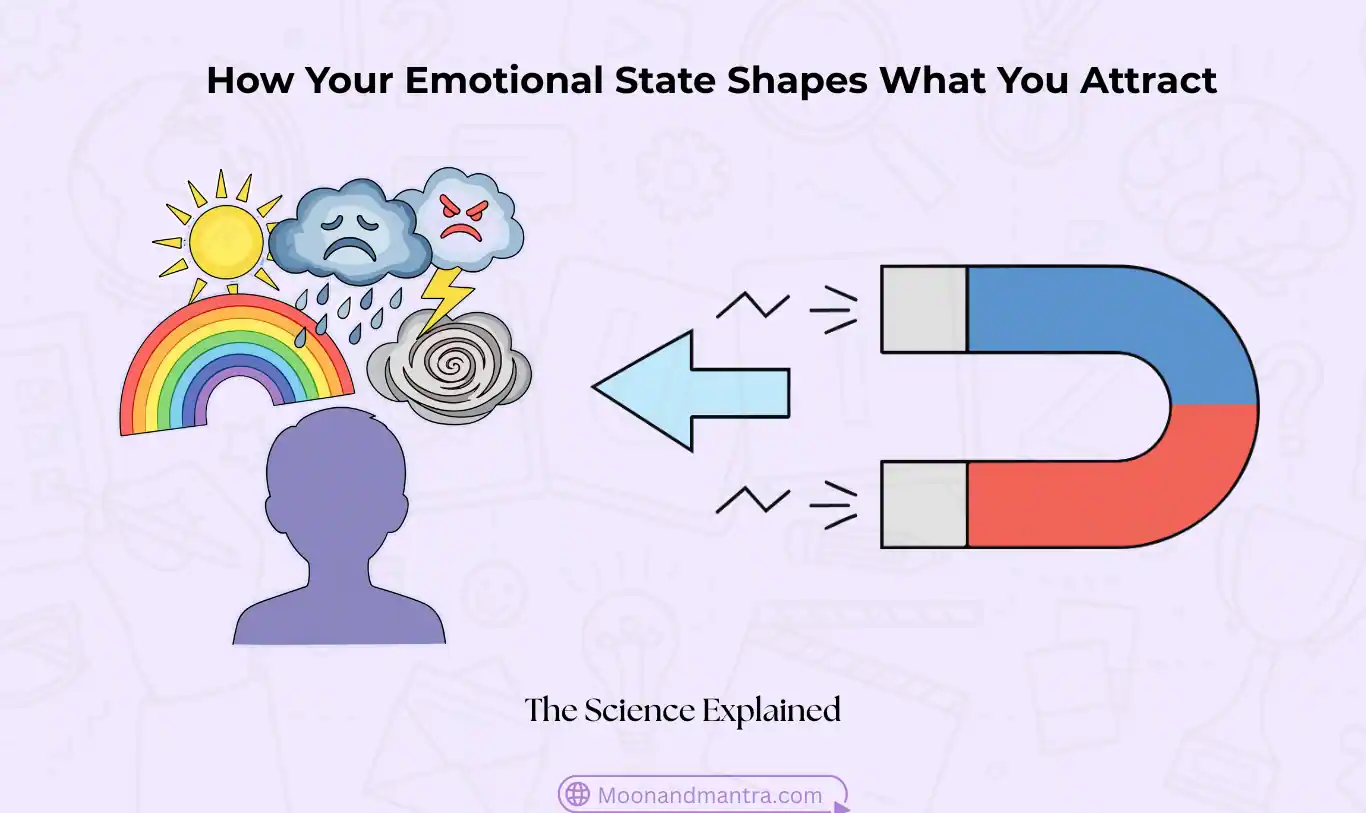
Your emotional state shapes what you attract more than you might realize. Whether it’s drawing in supportive relationships, unexpected opportunities, or recurring challenges, science shows that emotions act as a powerful filter for your reality. This isn’t mystical thinking, it’s grounded in psychology, neuroscience, and social dynamics.
From selective attention that highlights matching experiences to brain mechanisms that reinforce familiar patterns, your inner emotional world influences perceptions, decisions, and interpersonal connections. In this post, we’ll explore the evidence-based reasons behind this phenomenon and how understanding it can help you break negative cycles.
✨ If you’ve ever felt that intention alone isn’t enough, this may add clarity. Why Your Manifestation Is Not Working
Table of Contents
The Psychology Behind How Emotional State Shapes What You Attract
Psychology reveals that emotions aren’t just reactions they actively shape perception and behavior. One key mechanism is confirmation bias, where your brain prioritizes information that aligns with your current mood.
If you’re feeling anxious or unworthy, you unconsciously scan for evidence confirming those feelings like noticing rejection in neutral interactions. This bias creates a self-fulfilling loop: negative emotions lead to interpreting events negatively, which reinforces the original state and attracts more of the same.
Studies on motivated reasoning show how emotions distort memory and judgment, making people “prove” their inner narrative right, even when it’s painful. In relationships, this means someone in a low emotional state might gravitate toward partners who mirror insecurity, mistaking intensity for connection.
Emotional alignment plays a huge role too. Research on ideal versus actual affect indicates people pursue emotions that match cultural or personal ideals. Those valuing calm and positivity often attract stable opportunities, while chronic stress narrows focus to threats, limiting positive attractions.
Interpersonal psychology of attraction further explains this. Emotions influence likability: positive states make you more approachable, releasing signals of warmth that draw people in. Negative moods, however, can trigger avoidance through subtle cues like tone or body language.
Neuroscience: How the Brain Makes Your Emotional State Shape Attraction
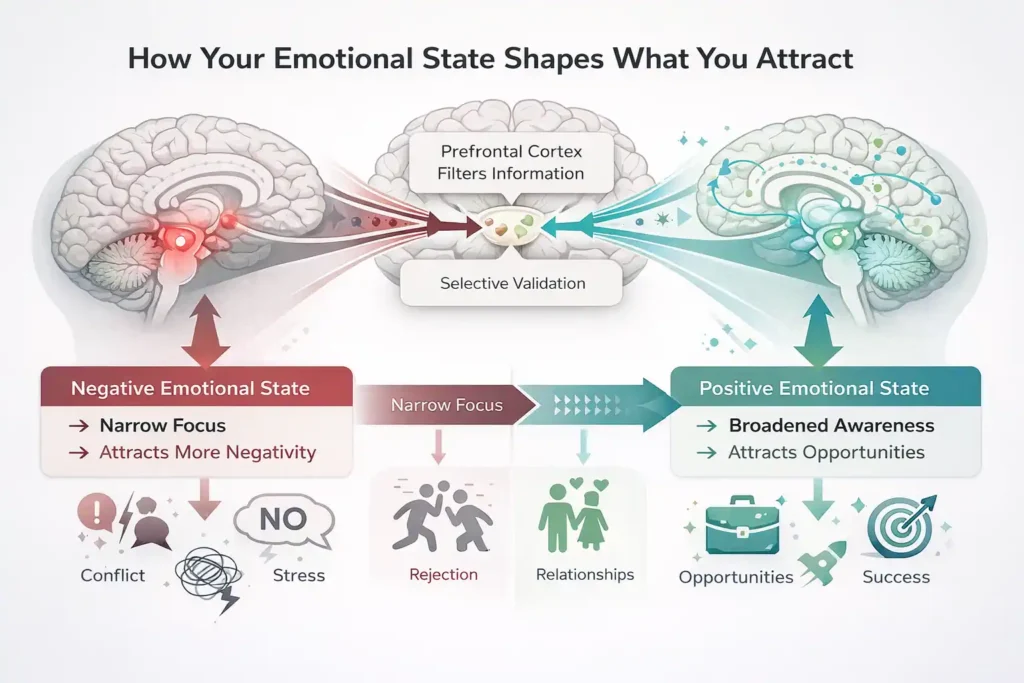
Neuroscience provides the biological “why” behind these patterns. The amygdala, your brain’s emotion center, processes feelings quickly and influences the prefrontal cortex, which handles attention and decisions.
Positive emotions trigger dopamine release, broadening neural pathways for creativity, opportunity recognition, and reward-seeking. This “broaden-and-build” effect helps you notice and pursue uplifting experiences, naturally attracting more positivity.
In contrast, stress hormones like cortisol narrow focus to survival threats. Chronic negativity heightens hypervigilance, making neutral events seem dangerous and pulling in more stress.
Brain imaging confirms confirmation bias has neural roots: when information challenges emotional beliefs, emotional regions override rational ones, reinforcing biased perceptions. This “emotional filtering” sculpts what enters awareness.
Emotional contagion also has a neurological basis. Mirror neurons fire when observing others’ emotions, syncing brain activity and spreading moods. An upbeat demeanor activates prosocial responses in others, enhancing connections and attracting harmonious interactions. Fear or anger, meanwhile, triggers defensive circuits, repelling closeness.
Neurotransmitters like serotonin stabilize moods for balanced perceptions, promoting steady attractions like reliable relationships or career growth. Overall, your brain literally rewires attention to match your dominant emotional state, shaping external realities over time.
Emotional Contagion: The Social Ripple Effect of Your Emotions
Emotions don’t stay internal they spread through emotional contagion, the automatic mimicry of moods in social settings. This phenomenon turns your state into a magnet for similar energies.
Massive studies (including viral network experiments) demonstrate how positivity or negativity propagates online and offline. A joyful vibe infects others, fostering supportive circles and opportunities. Negativity, however, can ripple discord, attracting conflict or withdrawal.
Intimacy amplifies this: closer relationships sync physiological responses (like heart rates), deepening bonds based on shared affect. In group dynamics, one person’s mood influences team performance and collective attractions.
Context matters clear social cues enhance mimicry via neural mirroring. An authentic positive emotional state triggers reciprocal warmth, making you more magnetic in dating, friendships, or professional networks.
Facial expressions and body language drive this process, linking empathy to stronger connections. By consciously cultivating uplifting emotions, you leverage contagion to draw in aligned people and experiences.
Real-Life Examples: How Emotional State Shapes What You Attract in Everyday Scenarios
To make the science more concrete, let’s look at everyday situations where your emotional state shapes what you attract in clear, observable ways.
In romantic relationships, someone consistently in a state of low self-worth often ends up in partnerships that reinforce that feeling. Psychology research on attachment styles shows how anxious or avoidant emotional patterns lead individuals to select (or interpret) partners who trigger the same old insecurities. Confirmation bias kicks in: small disagreements get amplified as proof of unworthiness, attracting more conflict and emotional distance.
Professionally, a chronic negative emotional state can sabotage opportunities. Studies on workplace affect demonstrate that people in pessimistic moods perceive feedback as criticism and networking events as threatening, leading them to withdraw. This self-isolation reduces chances of promotions, collaborations, or mentorships, literally attracting fewer career advancements.
Even in casual social settings, emotional contagion plays out daily. If you’re carrying resentment, your tone, facial micro-expressions, and energy repel friendly approaches while drawing in similarly frustrated people. Research on social mood transmission confirms this creates echo chambers of negativity.
On the flip side, cultivating a positive emotional state dramatically shifts outcomes. The broaden-and-build theory in positive psychology explains how joy and gratitude expand awareness, helping you spot serendipitous connections, like striking up meaningful conversations at events or receiving unexpected help. Over time, this compounds: positive interactions build confidence, which attracts more positivity in a virtuous cycle.
These examples aren’t coincidences, they’re the direct result of how your emotional state shapes what you attract through biased perception, selective attention, and interpersonal signaling. Recognizing these patterns is the first step toward intentional change.
The Role of Neuroplasticity in Rewiring Emotional Attraction Patterns
A key neurological reason repetitive patterns persist and why they can change is neuroplasticity, the brain’s ability to reorganize itself based on repeated experiences and emotional inputs.
Every time you dwell in a negative emotional state, neural pathways associated with threat detection and confirmation bias strengthen. The amygdala becomes more reactive, and the prefrontal cortex’s regulatory control weakens, making it easier to attract (and notice) matching negative events. This creates entrenched circuits that feel automatic.
Fortunately, neuroplasticity works both ways. Consistent practice of positive emotional regulation can literally reshape these pathways. For instance, regular mindfulness meditation has been shown in fMRI studies to decrease amygdala activity while increasing prefrontal cortex thickness leading to less reactive, more balanced perceptions.
Gratitude journaling, another evidence-based technique, boosts dopamine and serotonin, reinforcing reward circuits that make you more attuned to positive opportunities. Over weeks, this shifts your default emotional state, broadening what you notice and attract.
Emotional intelligence training also leverages neuroplasticity. By labeling emotions accurately and reframing situations, you weaken old biased connections and build new ones focused on possibility. Longitudinal studies show individuals who practice this report attracting healthier relationships and reduced stress cycles.
The process isn’t overnight, but science supports gradual rewiring: repeated positive emotional experiences create stronger neural associations with abundance, making your emotional state shapes what you attract more intentional and uplifting.
Why Negative Emotional Patterns Keep Repeating and How to Shift Them
Many people feel trapped in cycles where the same issues recur. Science points to emotional state as the culprit: habitual moods create perceptual biases that sustain patterns.
Early experiences wire the amygdala for certain responses, making familiar (even painful) dynamics feel “safe.” This leads to attracting similar situations through unconscious selection.
To break free, build emotional intelligence, recognizing and regulating states. Mindfulness calms the amygdala, reducing bias and opening perception to new possibilities.
Cognitive-behavioral techniques challenge distorted thoughts, countering confirmation bias. Expressing gratitude or savoring positives boosts dopamine, shifting toward abundance-oriented attractions.
Small daily practices like reframing negatives or surrounding yourself with uplifting influences leverage neuroplasticity. Over time, consistent positive shifts rewire your brain to notice and attract healthier realities.
Conclusion: Take Control of What Your Emotional State Attracts
Science confirms that your emotional state shapes what you attract through perception biases, neural filtering, and social contagion. Positive states broaden opportunities and connections, while negativity narrows them into familiar struggles.
By prioritizing awareness, regulation, and intentional positivity, you move from reactive patterns to empowered attraction. Start small: notice your mood, challenge biases, and cultivate emotions that align with your goals.
Your inner world isn’t just a reflection, it’s the architect of your outer one. Harness this knowledge, and watch what changes.
FAQs
Does emotional connection lead to attraction?
Emotional connection often increases attraction because shared emotional states influence perception, trust, and openness, shaping how people respond to each other.
What emotions do shapes represent?
In psychology and design, rounded shapes are often associated with safety and comfort, while sharp or angular shapes tend to evoke tension, alertness, or conflict.

3 thoughts on “How Your Emotional State Shapes What You Attract: The Science Explained”