
Why people believe in astrology is not a question about superstition as much as it is a question about human nature. Across cultures, eras, and belief systems, people have consistently looked for patterns that help them understand themselves, their relationships, and the uncertainty of life. Astrology has survived not because it promises control, but because it offers meaning.
To dismiss astrology as something people believe in blindly misses the deeper point. Most people do not turn to astrology because they expect perfect predictions. They turn to it because it gives language to experiences that feel difficult to articulate otherwise.
You may also find this helpful: 23+ ChatGPT Prompts For Self-Anaylsis
Table of Contents
The Human Need for Meaning
Humans are meaning-making beings. From the earliest cave markings to modern storytelling, we have always tried to connect events to narratives. Randomness feels unsettling. Patterns feel reassuring.
The meaning of astrology lies in this basic psychological impulse. Astrology provides a symbolic framework through which people can interpret emotions, relationships, and personal cycles. It does not demand belief in a literal sense. It invites reflection.
When someone reads about their zodiac sign and feels understood, the experience is less about believing the stars control them and more about feeling seen. Astrology becomes a mirror, not a command.
The Psychology Behind Astrology
The psychology behind astrology explains much of its enduring appeal. Psychological research shows that people naturally seek coherence in their lives, especially during periods of uncertainty. Astrology offers structured language at moments when emotions feel messy or overwhelming.
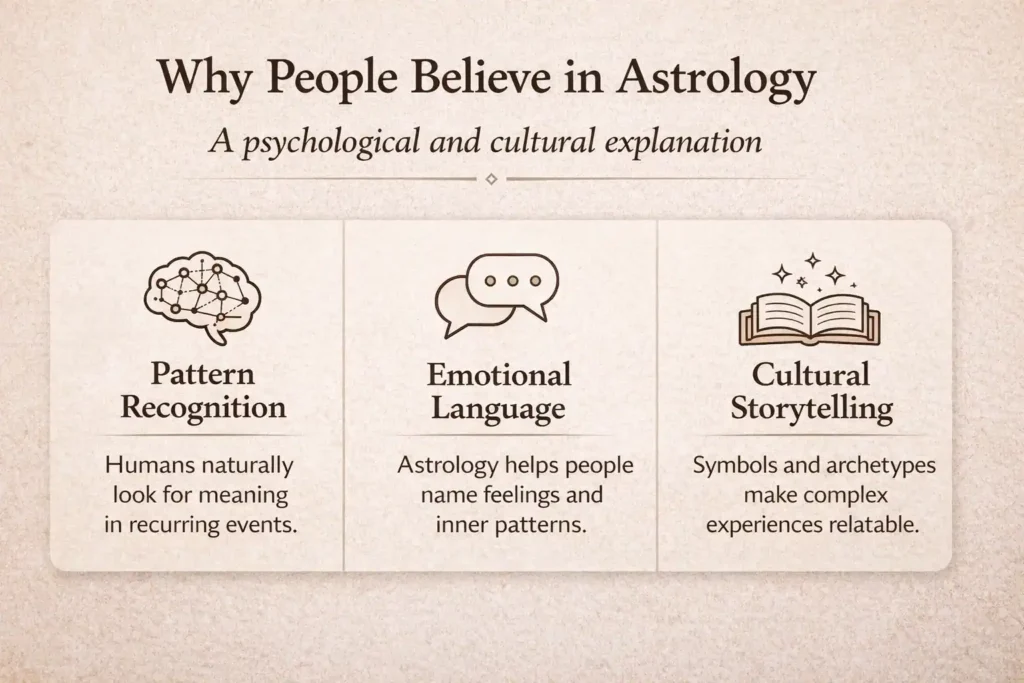
One reason astrology resonates is that it works through archetypes. Archetypes are symbolic patterns that appear across cultures and myths. When people read about personality traits associated with a sign, they often recognize parts of themselves, not because the description is universally true, but because it highlights aspects they are already aware of on some level.
This process is reflective, not deceptive. Astrology does not implant traits. It gives people a way to name what they already experience internally.
Astrology as a Tool for Self-Reflection
Many people engage with astrology without asking whether it is objectively true. Instead, they ask whether it feels useful. Astrology becomes a tool for self-inquiry, similar to journaling, personality frameworks, or reflective prompts.
This is why do people still believe in astrology remains a relevant question even in scientifically literate societies. Belief, in this context, is not rigid. It is flexible. People use astrology selectively, thoughtfully, and often metaphorically.
For some, astrology helps articulate emotional patterns. For others, it offers reassurance during transitions. In both cases, astrology functions less as prediction and more as interpretation.
Why Skeptics Still Find Astrology Interesting
Interestingly, many people who describe themselves as skeptics still engage with astrology. They may not rely on it for decision-making, but they read, reflect, and sometimes relate.
This happens because astrology does not require full belief to be meaningful. Symbolic systems work even when taken lightly. Much like literature or mythology, astrology can be explored without literal acceptance.
The psychology behind astrology explains this paradox. Humans are capable of holding symbolic ideas without treating them as factual claims. Astrology occupies that middle space where curiosity meets introspection.
Astrology and Emotional Language
One of astrology’s strongest functions is emotional translation. People often struggle to articulate feelings, especially complex or contradictory ones. Astrology provides vocabulary.
Instead of saying, “I feel conflicted, sensitive, and unsure,” someone might say, “This feels like a Pisces phase.” The label simplifies emotional complexity without dismissing it.
This is a key reason why people believe in astrology even when they do not depend on it. It helps organize emotional experience in a non-threatening way.
Cultural Normalization of Astrology
Astrology is also socially reinforced. It appears in media, conversation, and digital culture. Compatibility discussions, rising signs, and planetary transits have become shared reference points.
This normalization does not create belief from nothing, but it makes engagement easier. Astrology becomes a common language, not a fringe practice.
When people ask do people still believe in astrology, the answer is nuanced. Many people do not believe in astrology as an absolute truth system. They believe in it as a lens, a tool, or a source of insight.
Astrology and Control in an Uncertain World
Modern life often feels unpredictable. Careers shift. Relationships change. Global events disrupt stability. In such environments, systems that provide structure gain renewed relevance.
Astrology offers cycles. It suggests that phases pass, that emotions move, that timing matters. Even without literal belief, this framework can feel grounding.
The meaning of astrology here is not control, but context. It reassures people that change is part of a larger pattern, not a personal failure.
Astrology Compared to Other Reflective Systems
Astrology is not unique in its function. Personality tests, therapeutic frameworks, and spiritual practices all serve similar purposes. They help people understand behavior, tendencies, and emotional responses.
What sets astrology apart is its symbolic richness. It combines time, story, and identity in a way few other systems do. This makes it emotionally engaging rather than purely analytical.
The psychology behind astrology suggests that people are drawn to systems that feel both structured and imaginative. Astrology sits comfortably at that intersection.
Psychology Today examines why people connect with astrology through symbolism, self-reflection, and meaning-making.
Read the VeryWell Mind perspective
Why Astrology Persists Across Generations
Astrology has survived for thousands of years because it adapts. It does not remain fixed. Cultural interpretations shift. Language evolves. Applications change.
Older forms of astrology focused on fate and events. Modern astrology focuses more on self-awareness and emotional insight. This evolution allows astrology to remain relevant without demanding belief in outdated assumptions.
This adaptability explains why people believe in astrology differently across time. What belief means today is not what it meant centuries ago.
Astrology as a Personal, Not Universal, Practice
It is important to note that astrology does not function the same way for everyone. Some people resonate deeply with it. Others feel indifferent. Neither response is wrong.
Astrology works best when treated as a personal interpretive tool rather than a universal truth. When people approach it with curiosity instead of dependence, it enhances self-understanding without replacing critical thinking.
This balanced engagement is why do people still believe in astrology remains an open question rather than a definitive yes or no.
The Modern Meaning of Astrology
In the modern world, astrology is less about prediction and more about reflection. It is woven into conversations about identity, emotions, and relationships. It helps people pause, observe, and contextualize their experiences.
The meaning of astrology today lies in its ability to bridge logic and feeling. It does not demand certainty. It offers perspective.
A Closing Thought
Astrology endures not because it answers every question, but because it asks the right ones. It invites people to reflect on who they are, how they feel, and where they are in their personal cycles.
That is ultimately why people believe in astrology. Not because it promises control over life, but because it helps people feel connected to it.
FAQs
Why do people believe astrology is real?
Many people relate to astrology because it reflects emotional patterns and life experiences in a symbolic way, even if they don’t view it as scientifically exact.
Why should one believe in astrology?
Astrology doesn’t require belief to be useful. Some people engage with it as a tool for self-reflection, emotional awareness, and understanding personal patterns.
What kind of people believe in astrology?
People across different ages, cultures, and education levels engage with astrology, often out of curiosity, self-exploration, or a desire for meaning rather than literal belief.
