

How to regulate nervous system? is a question many people ask when stress begins to feel constant. The good news is that nervous system regulation isn’t about avoiding difficult emotions. It’s about helping your body feel safe, recover from stress and develop a calm nervous system through simple, science-backed practices that support emotional balance and resilience.
Table of Contents
What Is Nervous System Regulation?
Nervous system regulation is your body’s ability to respond to stress, recover from it and return to a state of balance. It doesn’t mean eliminating stress altogether. Instead, it means developing the flexibility to move through challenging situations without remaining stuck in a constant state of tension or overwhelm.
Your autonomic nervous system (ANS) controls many automatic functions, including your heart rate, breathing, digestion and stress response. It has two primary branches:
- Sympathetic Nervous System: Often called the “fight or flight” system, it prepares your body to respond to challenges by increasing alertness, heart rate and energy.
- Parasympathetic Nervous System: Known as the “rest and digest” system, it helps your body slow down, recover and restore a sense of safety after stressful experiences.
Both systems are essential. The goal of regulating nervous system function isn’t to switch off your stress response, but to help your body move between activation and relaxation more efficiently. When this balance improves, you become more resilient, recover from stressful situations more quickly and find it easier to experience a calm nervous system.
Modern life often keeps many people in a prolonged state of alertness through constant notifications, busy schedules, poor sleep and chronic stress. Over time, this can make it more difficult for the body to recognize when it’s safe to relax.
The encouraging news is that nervous system regulation is a skill that can be strengthened. Through small, consistent practices such as breathing exercises, mindful movement, social connection and restorative rest, you can gradually teach your nervous system to return to a calmer, more balanced state.
Why a Calm Nervous System Matters
A calm nervous system doesn’t mean you’ll never feel stressed, anxious or overwhelmed. Stress is a natural part of life and your nervous system is designed to respond to it. The difference lies in how quickly your body can recover and return to a state of balance once the challenge has passed.
When your nervous system spends too much time in a heightened state of alertness, even everyday situations can begin to feel exhausting. Small inconveniences may trigger strong emotional reactions, decision-making becomes more difficult, sleep may feel less restorative and your mind can remain constantly occupied. Over time, this can leave you feeling as though you’re always “on,” even during moments that should feel safe or relaxing.
This is why nervous system regulation matters. Rather than trying to eliminate stress, it helps your body become more adaptable. A well-regulated nervous system allows you to respond thoughtfully instead of reacting automatically, recover more easily after setbacks and experience greater emotional resilience in everyday life.
Research increasingly supports this approach. Studies from Stanford Medicine have shown that simple breathing practices can positively influence the autonomic nervous system, while researchers at UCSF, including Dr. Alexandra Crosswell and Dr. Elissa Epel, describe how contemplative practices such as mindful breathing, meditation and body awareness help the body enter a state of “deep rest” that supports recovery from chronic stress.
With consistent practice, regulating nervous system responses becomes less about controlling your emotions and more about giving your body the conditions it needs to feel safe, balanced and resilient.
Signs Your Nervous System May Need More Support
Stress affects everyone differently, and experiencing these signs doesn’t necessarily mean something is wrong. However, if several of them feel familiar, it may be your body’s way of asking for more rest, regulation and recovery.
You may benefit from nervous system regulation if you frequently experience:
- Feeling constantly “on edge,” even when nothing stressful is happening.
- Finding it difficult to relax or slow your thoughts.
- Becoming easily overwhelmed by everyday situations.
- Feeling emotionally reactive instead of responding calmly.
- Struggling to concentrate or make clear decisions.
- Waking up tired, even after a full night’s sleep.
- Feeling safe only when you’re busy or productive.
The encouraging news is that your nervous system is adaptable. Research shows that consistent practices such as mindful breathing, gentle movement and social connection can strengthen your body’s ability to recover from stress over time. The next section explores simple, science-backed ways to regulate nervous system function that you can begin practicing today.
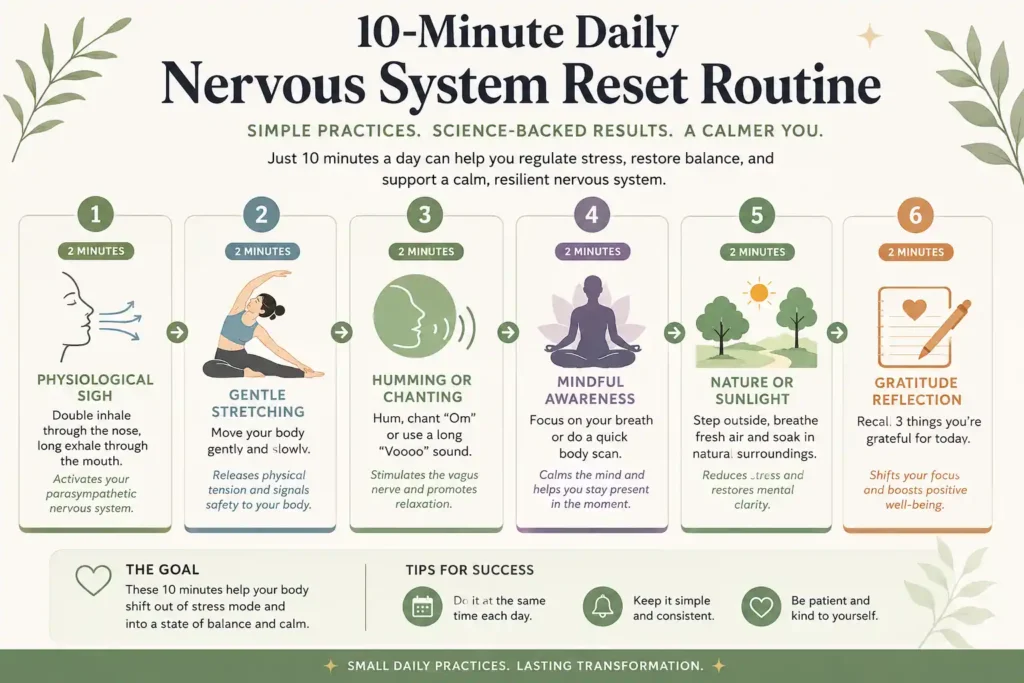
8 Science-Backed Ways to Regulate Your Nervous System
Developing a calm nervous system isn’t about finding one perfect technique. Research suggests that small, consistent practices are far more effective than occasional intensive efforts. Here are eight evidence-based ways to support nervous system regulation and help your body return to a greater sense of balance.
1. Practice Slow Breathing with Longer Exhales
One of the simplest ways to regulate nervous system function is through your breath. Slow breathing, particularly with a longer exhale than inhale, activates the parasympathetic nervous system, helping your body shift out of “fight or flight” and into a calmer state.
A technique known as the Physiological Sigh has been studied by researchers at Stanford Medicine, including Dr. David Spiegel and Dr. Andrew Huberman. In a randomized controlled trial, participants who practiced this breathing exercise daily experienced greater improvements in mood and reductions in respiratory rate than those practicing mindfulness meditation alone.
Try this:
- Take a deep inhale through your nose.
- Before exhaling, take one more short inhale.
- Slowly exhale through your mouth until your lungs feel empty.
- Repeat for 1–5 minutes whenever you feel overwhelmed.
Over time, this simple practice can improve your body’s ability to recover from everyday stress.
Learn more:
- Stanford Medicine News – Breathing practices improve mood more than mindfulness meditation: https://med.stanford.edu/news/insights/2023/02/cyclic-sighing-can-help-breathe-away-anxiety.html
- Cell Reports Medicine – Randomized Controlled Trial on Cyclic Sighing: https://www.cell.com/cell-reports-medicine/fulltext/S2666-3791(22)00587-8
2. Move Your Body Gently
When you’re stressed, your body prepares for action. Your muscles tighten, your breathing changes and stress hormones increase to help you respond to a perceived threat. Gentle movement helps complete this stress response, signaling to your nervous system that the danger has passed and it’s safe to relax.
You don’t need an intense workout to experience the benefits. In fact, rhythmic, low-impact activities are some of the most effective forms of nervous system regulation. Research has found that practices such as walking, yoga and tai chi can improve heart rate variability (HRV), an important indicator of a resilient and adaptable nervous system.
Try this:
- Take a 10–20 minute walk outdoors.
- Practice gentle yoga or stretching.
- Try tai chi or other slow, mindful movement.
- Focus on moving with your breath rather than exercising for performance.
Consistency matters more than intensity. Even a few minutes of intentional movement each day can help develop a calm nervous system over time.
Learn more:
- Greater Good Science Center (UC Berkeley): https://greatergood.berkeley.edu/
- Harvard Health – Exercise and Stress: https://www.health.harvard.edu/staying-healthy/exercising-to-relax
3. Lean on Safe Social Connections
Think about the last time you spoke with someone who made you feel genuinely understood. Chances are you felt calmer afterward. That’s not just an emotional experience, it’s also a biological one.
According to Dr. Stephen Porges’ Polyvagal Theory, your nervous system is constantly looking for cues of safety. A warm conversation, kind eye contact, a reassuring voice or simply being around someone you trust can activate your body’s social engagement system, helping shift you out of “fight or flight” and into a calmer, more connected state.
This process, often called co-regulation, reminds us that emotional resilience isn’t something we always build alone. Sometimes, another person’s calm presence helps our own nervous system settle.
Try this:
- Call or meet someone who makes you feel safe.
- Maintain gentle eye contact during conversations.
- Practice active listening without distractions.
- Spend time with people who leave you feeling more grounded than drained.
Strong relationships don’t remove stress, but they can make it easier for your nervous system to recover from it.
Learn more:
- Polyvagal Institute: https://www.polyvagalinstitute.org/
- Society for Personality and Social Psychology: https://spsp.org/
4. Practice Mindfulness and Body Awareness
Many people think mindfulness means clearing the mind completely. In reality, it’s simply the practice of noticing your thoughts, emotions and physical sensations without immediately reacting to them.
This gentle awareness sends an important message to your brain: I am safe enough to slow down. Over time, practices such as meditation, body scans and progressive muscle relaxation can strengthen your ability to regulate emotional responses instead of becoming overwhelmed by them.
Researchers Dr. Alexandra Crosswell and Dr. Elissa Epel at UCSF describe these practices as pathways to deep rest—a restorative state that allows the body to recover from chronic stress and restore energy.
Try this:
- Spend five minutes noticing your breath without changing it.
- Do a simple body scan from head to toe.
- Practice progressive muscle relaxation before bed.
- Observe your thoughts with curiosity instead of judgment.
Mindfulness isn’t about escaping difficult emotions. It’s about creating enough space to respond to them with greater clarity and compassion.
Learn more:
- UCSF Department of Psychiatry and Behavioral Sciences: https://psych.ucsf.edu/
- Mindfulness-Based Stress Reduction (MBSR): https://www.umassmed.edu/cfm/mindfulness-based-programs/mbsr-courses/
5. Use Your Voice to Stimulate the Vagus Nerve
One of the simplest ways to support nervous system regulation is something you already do every day—using your voice. Humming, singing, chanting or making a long “vooo” sound creates gentle vibrations around the larynx, which can stimulate branches of the vagus nerve and encourage a parasympathetic, or calming, response.
This idea is supported by Dr. Stephen Porges’ Polyvagal Theory, which explains how vocalization plays an important role in the body’s social engagement system. It’s one reason why singing your favorite song or humming while you work can naturally leave you feeling more relaxed.
Try this:
- Hum your favorite tune for 2–3 minutes.
- Chant “Om” or a simple calming mantra.
- Slowly repeat the sound “Voooo” on a long exhale.
- Sing along to music that helps you feel peaceful.
The goal isn’t to sound perfect, it’s to create gentle vibration that signals safety to your nervous system.
Learn more:
- Polyvagal Institute: https://www.polyvagalinstitute.org/
- Society for Personality and Social Psychology: https://spsp.org/
6. Try Gentle Cold Exposure
You don’t need to jump into an ice bath to experience the benefits of cold exposure. Even brief, gentle exposure to cold can help your body become more adaptable to stress.
Cold water activates the body’s dive reflex, a natural response that can slow the heart rate and encourage a shift toward a calmer physiological state. Over time, this can improve your ability to recover from everyday stress.
If you’re new to cold exposure, start gradually.
Try this:
- Finish your shower with 20–30 seconds of cool water.
- Splash cold water on your face in the morning.
- Increase the duration only if it feels comfortable.
Cold exposure should feel refreshing, not overwhelming. If you have underlying cardiovascular or medical conditions, speak with a healthcare professional before trying more intensive forms of cold therapy.
Learn more:
- Cleveland Clinic: https://health.clevelandclinic.org/
7. Spend More Time in Nature
Sometimes the best way to regulate nervous system function is simply to step outside.
Nature naturally encourages slower breathing, softer attention and reduced mental stimulation. Whether it’s a quiet park, a forest trail or simply sitting beneath a tree, spending time outdoors can help interrupt the constant state of alertness that modern life often creates.
Research from the Greater Good Science Center at UC Berkeley suggests that regular contact with nature supports emotional well-being and resilience, while walking itself provides gentle rhythmic movement that further benefits the nervous system.
Try this:
- Take a walk without your phone.
- Sit in a park for ten minutes.
- Notice the sounds, colors and textures around you.
- Spend a few moments watching the sky or listening to birds.
Nature doesn’t demand your attention, it simply invites your nervous system to slow down.
8. Prioritize Restful Sleep and Recovery
Every practice in this guide supports a calm nervous system, but sleep is the foundation that allows all of them to work more effectively.
During sleep, your brain and body recover from the demands of the day, process emotions and restore energy. Without adequate rest, even the best ways to regulate nervous system function become less effective because your body never receives enough time to reset.
Improving your sleep doesn’t always require dramatic changes. Small, consistent habits often have the greatest impact.
Try this:
- Go to bed and wake up at roughly the same time each day.
- Reduce screen exposure 30–60 minutes before bed.
- Keep your bedroom cool, quiet and dark.
- Create a relaxing bedtime routine with reading, stretching or mindful breathing.
A well-rested nervous system is naturally more resilient, making it easier to navigate stress with greater patience, clarity and emotional balance.
Learn more:
- Harvard Health – Healthy Sleep: https://www.health.harvard.edu/topics/sleep
- National Sleep Foundation: https://www.thensf.org/
FAQs
How do I reset my nervous system?
Resetting your nervous system doesn’t happen through one quick fix, but through consistent habits that signal safety to your body. Practices such as slow breathing, gentle movement, mindfulness, supportive social connection and quality sleep can all support nervous system regulation. Even spending 10 minutes a day on these activities can help your body recover from stress more effectively over time.
What exercise is good for the nervous system?
The best exercises for a calm nervous system are those that combine gentle movement with mindful breathing. Walking, yoga, tai chi, stretching and other low-impact rhythmic activities have been shown to support emotional regulation and improve resilience. The goal isn’t intense physical effort, but helping your body move from a state of stress toward one of balance and recovery.

1 thought on “How to Regulate Nervous System: Gentle Ways to Calm Your Nervous System”